

Buying a meat saw is not simply about finding a machine that cuts meat.
The right commercial meat saw should fit your production volume, the products you process, your available space, your workflow, your electrical supply and your plans for growth.
If you choose based only on price, you could end up with equipment that cannot handle your workload, takes too long to clean, creates a new bottleneck or leaves you paying for capacity you do not actually need.
Before you buy, start with the operation.
Who Is a Meat Saw For?
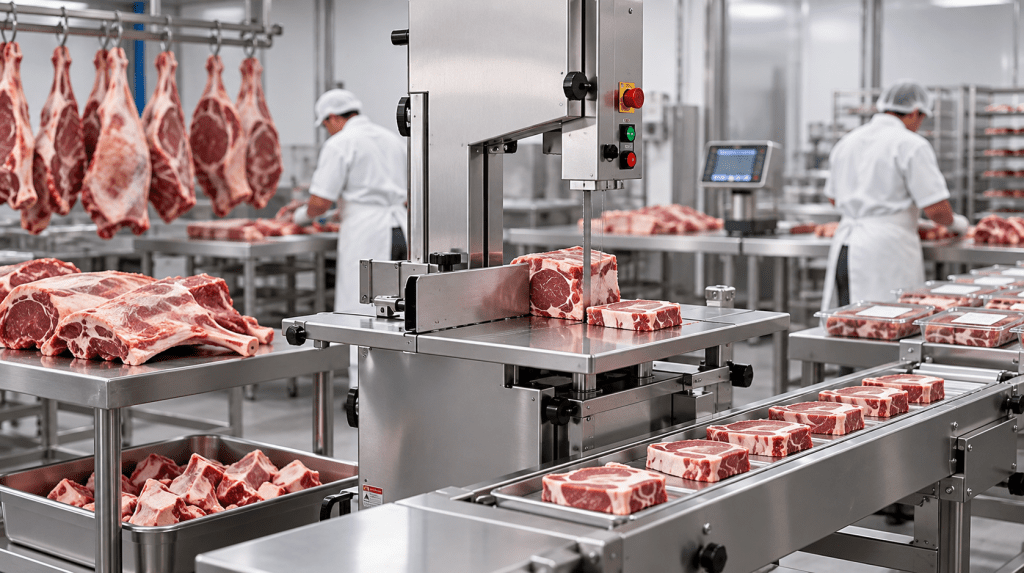
A commercial meat saw can be useful for businesses that regularly process or portion larger cuts of meat and need greater speed, consistency and control than manual cutting can provide.
A meat saw may be suitable for:
- Butcher shops
- Meat-processing businesses
- Supermarkets with in-house meat departments
- Restaurants processing larger quantities of meat
- Hotels and catering operations
- Farms processing meat for commercial sale
- Food manufacturers
- Poultry and meat processors
- Businesses moving from small-batch to higher-volume production
If your team is spending significant time manually cutting large portions, bone-in meat or other difficult-to-process products, a meat saw may help reduce the workload and improve production flow.
But before choosing a machine, ask yourself:
What problem do I need this meat saw to solve?
Start With Your Production Bottleneck
The best equipment purchase starts with identifying where your production is slowing down.
A meat saw can improve the cutting stage, but if cutting is not actually your biggest bottleneck, purchasing one may not solve the underlying problem.
1. Cutting Takes Too Long
If employees are spending hours manually cutting large pieces of meat, your production capacity may be limited by labour rather than demand.
A suitable commercial meat saw can make repetitive cutting faster and more consistent.
This can free your team to focus on other parts of the operation.
2. Your Portions Are Inconsistent
Manual cutting can make it difficult to produce consistent portions.
For businesses selling meat by weight or preparing standardised cuts, consistency can affect:
- Portion control
- Product presentation
- Yield
- Pricing
- Packaging
- Customer expectations
The objective is not simply to cut faster. It is to create a more repeatable process.
3. Too Much Labour Is Going Into Cutting
If skilled employees spend a large portion of their day performing repetitive cutting tasks, labour is being tied up in one stage of production.
The right equipment can help move repetitive work into a more efficient process.
That means your team can spend more time on activities that require judgement, customer service and production oversight.
4. Your Production Volume Is Increasing
The equipment that worked when you were processing a small quantity may not be suitable once your business starts handling significantly more orders.
If your production has increased, look at:
- Daily volume
- Peak production periods
- Number of operators
- Cutting time
- Product size
- Future growth
Your equipment should support the business you are building, not just the business you have today.
5. You Are Processing Larger or Bone-In Products
Certain businesses regularly work with larger cuts or bone-in products that are difficult and time-consuming to process manually.
If this is part of your operation, make sure the machine you select is actually designed for the products you intend to process.
What Equipment Should You Consider?
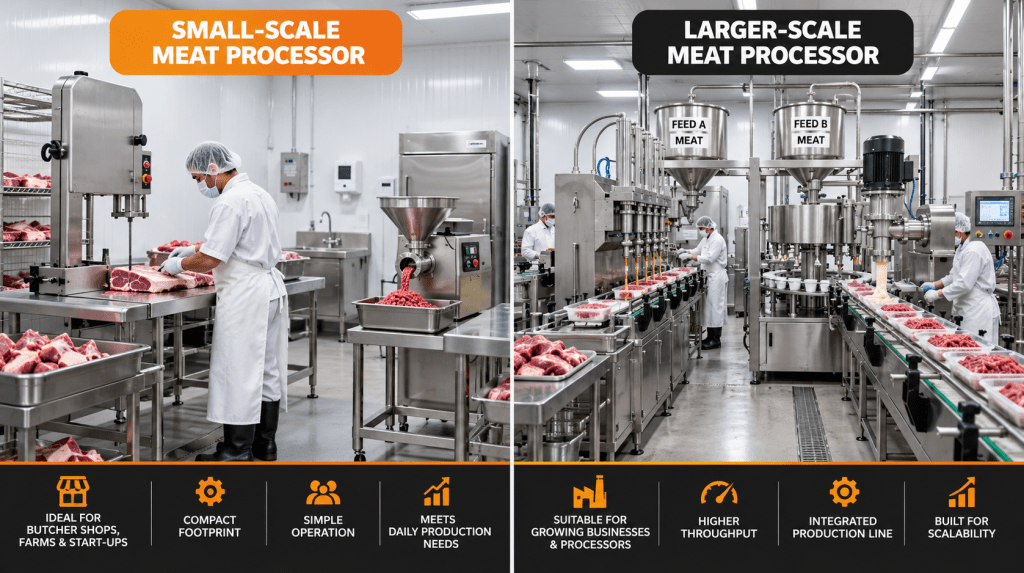
A meat saw is only one part of a meat-processing operation.
Depending on your business, you may also need equipment that supports the stages before and after cutting.
| Equipment | What It Supports |
|---|---|
| Meat Band Saw | Cutting meat, bones and larger portions |
| Meat Grinder | Grinding meat into mince and other processed formats |
| Meat Slicer | Producing consistent slices |
| Meat Tenderiser | Preparing cuts for further processing |
| Stainless Steel Work Table | Preparation and handling |
| Commercial Scales | Weighing and portion control |
| Refrigeration Equipment | Maintaining chilled products |
| Freezing Equipment | Frozen product storage and handling |
| Vacuum Packaging Equipment | Packaging and extending product shelf life |
| Sealing Equipment | Preparing packaged products for sale |
The right combination depends on your production process.
For example, a small butcher shop preparing retail portions may need a very different setup from a processor supplying restaurants, supermarkets or wholesale customers.
What to Check Before Buying a Meat Saw
This is where equipment purchases often go wrong.
Instead of starting with:
“How much does it cost?”
Start with:
“Does it fit my operation?”
1. Cutting Capacity
Look at the machine’s actual cutting capacity.
Check specifications such as:
- Maximum cutting height
- Cutting width
- Blade dimensions
- Product dimensions
- Cutting capacity
- Suitable product types
The machine needs to accommodate the products you actually process.
Do not choose based solely on an advertised maximum capacity.
2. Your Production Volume
Calculate approximately how much meat you process during a normal production day.
Consider:
How many pounds or kilograms do we currently process?
Then consider:
How much could we realistically process as the business grows?
This helps you avoid buying equipment that is either too small for your operation or unnecessarily large for your current needs.
3. Motor Power
Motor power is important, but it should not be considered on its own.
Look at motor power together with:
- Cutting capacity
- Product type
- Blade size
- Duty cycle
- Production volume
- Electrical requirements
A higher-powered machine is not automatically the right machine for your business.
The specifications need to work together.
4. Electrical Requirements
Before purchasing, confirm that your facility can support the machine.
Check:
- Voltage
- Phase
- Frequency
- Power requirements
- Plug requirements
- Available electrical supply
This is particularly important when importing commercial equipment.
A machine can look perfect on paper but become a problem if your facility is not equipped for its electrical requirements.
5. Machine Dimensions
Measure the area where the machine will actually operate.
Do not measure only the available floor space.
Consider:
- Machine footprint
- Operator working space
- Clearance around the machine
- Doorway dimensions
- Delivery access
- Cleaning access
- Product movement
- Storage
Your operator needs sufficient space to work efficiently. The machine also needs to fit into the overall production workflow.
6. Construction and Materials
Look carefully at the machine’s construction and the materials used in product-contact areas.
For commercial food-processing environments, stainless steel construction can offer durability and practical cleaning benefits.
Also consider how exposed components, work surfaces and other areas will be maintained over time.
7. Cleaning and Maintenance
One of the most important questions to ask before buying is:
“How easy is this machine to clean and maintain?”
Find out:
- How the blade is cleaned
- Which components can be removed
- How easily food residue can be accessed
- Whether difficult-to-reach areas exist
- What routine maintenance is required
- Which replacement parts are available
- How frequently wear components need attention
A machine that saves cutting time but creates hours of additional cleaning is not necessarily improving your operation.
Think about the entire production cycle:
Prepare → Cut → Weigh → Package → Clean → Maintain
Safety Should Be Part of the Buying Decision
A meat saw is powerful cutting equipment, so safety needs to be considered before the machine enters your production environment.
Depending on the model, look for appropriate features such as:
- Blade guards
- Emergency stop controls
- Product guides
- Stable construction
- Appropriate operator controls
- Safe access for cleaning
- Clear operating procedures
Your team should also receive appropriate training before operating the equipment.
The objective is not simply to purchase a machine.
It is to introduce the machine into a workflow that your team can operate safely and consistently.
Mistakes to Avoid When Buying a Meat Saw
Mistake #1: Buying Based Only on Price
The cheapest machine is not necessarily the lowest-cost option for your business.
Consider the total cost of ownership, including:
- Purchase
- Shipping
- Installation
- Training
- Maintenance
- Replacement parts
- Downtime
- Cleaning
- Labour
A machine that does not match your operation can become expensive over time.
Mistake #2: Buying More Capacity Than You Need
More capacity is not automatically better.
A larger machine may require:
- More space
- More power
- Higher investment
- Different installation requirements
- Additional workflow considerations
Choose capacity according to your actual production requirements and realistic growth plans.
Mistake #3: Ignoring Your Electrical Supply
Do not wait until the equipment arrives to discover that your facility cannot support it.
Confirm the electrical requirements before placing the order.
Mistake #4: Ignoring the Rest of Your Workflow
- Where does the meat come from?
- Where does it go after cutting?
- Where is it weighed?
- Where is it packaged?
- Where is it stored?
If the meat saw is positioned incorrectly, you could simply move your bottleneck from one part of the operation to another.
Mistake #5: Forgetting About Cleaning
Production speed is only one part of productivity.
If the machine takes too long to clean, maintain or prepare between production runs, that time needs to be considered when evaluating the equipment.
Mistake #6: Buying Only for Today’s Production
Your business may grow. If you expect production volume to increase, discuss that before choosing your machine.
You don’t necessarily need the largest machine available; you need a machine that gives you the capacity and flexibility your business actually requires.

Three Sample Meat Saw Setup Paths
There is no single setup that works for every meat-processing business. Your ideal configuration depends on your products, production volume, facility and workflow.
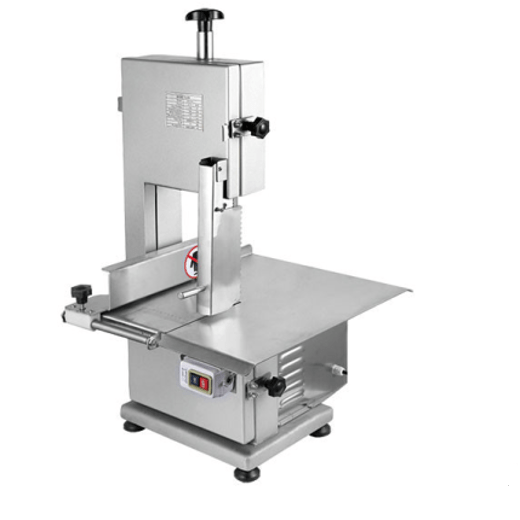
Entry-Level Setup
Best suited to: Smaller butcher shops, farms, restaurants and businesses starting commercial meat processing.
Example workflow:
Receiving → Cold Storage → Meat Saw → Weighing → Packaging → Finished Storage
At this stage, your priorities may include:
- Reliable cutting
- Appropriate capacity
- Simple operation
- Manageable footprint
- Easy cleaning
- Straightforward maintenance
- Operator training
You don’t necessarily need a large industrial system if your production volume is still relatively low.

Mid-Level Setup
Best suited to: Growing butcher shops, supermarkets and processors handling consistent daily production.
Example workflow:
Cold Storage → Preparation → Meat Saw → Grinder/Slicer → Weighing → Packaging → Cold Storage
At this stage, the meat saw needs to work as part of a larger production process.
Your priorities may include:
- Higher throughput
- Consistent portions
- Reduced manual labour
- Better workflow
- Equipment coordination
- Easier cleaning
- Maintenance support
The focus moves from purchasing one machine to building a more efficient production system.
Higher-Capacity Setup
Best suited to: Established meat processors and operations handling substantially higher production volumes.
Example workflow:
Receiving → Cold Storage → Preparation → Cutting → Further Processing → Portioning → Packaging → Finished Cold Storage
At this level, equipment selection should be based on the entire production system.
You may need to consider:
- Higher-capacity cutting equipment
- Additional processing machinery
- Refrigeration
- Packaging equipment
- Material handling
- Production scheduling
- Maintenance planning
- Staff training
- Technical support
The question becomes:
“How should my production system work?”
Rather than simply:
“Which meat saw should I buy?”

Entry-Level vs Mid-Level vs Higher-Capacity
| Consideration | Entry-Level | Mid-Level | Higher-Capacity |
|---|---|---|---|
| Production | Smaller batches | Regular daily production | High-volume production |
| Main priority | Reliable cutting | Speed and consistency | Throughput and workflow |
| Space | Smaller footprint | Dedicated processing area | Larger production facility |
| Workflow | Simple | Multiple processing stages | Integrated production system |
| Labour focus | Reduce manual cutting | Improve productivity | Optimise the wider operation |
| Equipment planning | Individual machine | Equipment combination | Complete production system |
| Support | Training and basic maintenance | Ongoing support | Structured technical support |
These are planning categories rather than fixed machine classifications. The correct equipment should always be selected according to your actual production requirements.
Need help selecting the right meat saw to complete production line?
Before You Request a Quote, Know These Numbers
Having the right information ready can make equipment selection much easier.
Your Product
- What type of meat are you processing?
- Are you cutting bone-in products?
- Are products fresh, chilled or frozen?
- What are the typical product dimensions?
- What portion sizes do you need?
Your Production
- How much do you process per day?
- How many days per week?
- How many operators will use the machine?
- How much time is currently spent cutting?
- What is your expected production growth?
Your Facility
- What electrical supply is available?
- How much floor space is available?
- Where will the machine be positioned?
- How will product move into the cutting area?
- How will product move out of the cutting area?
Your Future Plans
- Are you increasing production?
- Are you adding new products?
- Are you moving into wholesale?
- Will you add grinders, slicers or packaging equipment?
- Will you need additional refrigeration?
The more clearly you understand these requirements, the easier it becomes to select equipment that fits your business.
Equipment Is Only the Beginning
Buying the right machine is important.
Knowing how to use it properly, integrate it into your workflow and maintain it is just as important.
At YES, support can extend beyond equipment procurement through consultation, procurement assistance, installation and training, with ongoing technical and maintenance support available for businesses that need it.
Because the goal is not simply to put a meat saw in your facility.
The goal is to help you build a production setup that works for your business.
You want it, we supply it.
Every meat-processing operation has different requirements. The wrong meat saw can lead to inconsistent cuts, production bottlenecks, wasted labour, and unnecessary costs.
Schedule a consultation, and we’ll help determine the right meat saw and setup based on your product type, cutting volume, workspace, workflow, and growth plans.


