

Client Snapshot
From limited batches to scalable, consistent production in record time.
Business: A&J’s Premium Ice Cream
Owner: Anthony & June Henry
Location: Based in Trinidad, serving customers nationwide
Operation Type: Homemade Ice Cream
YES Equipment:
1. BEFORE → AFTER TRANSFORMATION
The batch freezer became the engine behind production growth.
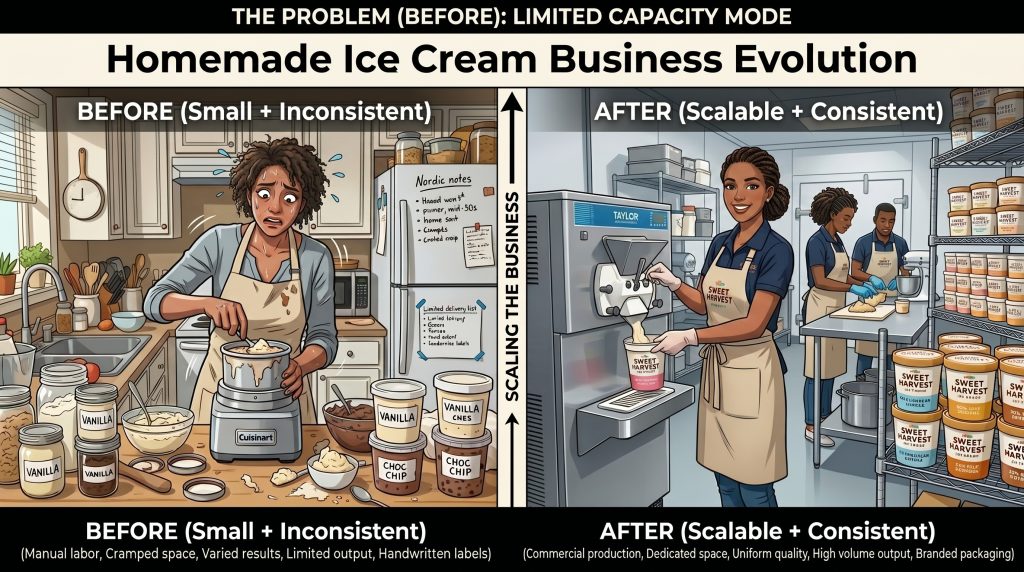
THE PROBLEM (BEFORE): LIMITED CAPACITY MODE
A&J’s Premium Ice Cream was growing, but production capacity was becoming the constraint.
The upgrade to a larger batch freezer helped the business move from limited small-batch production into a more scalable and consistent production system.
BEFORE (Small + Inconsistent) | AFTER (Scalable + Consistent) |
| Production speed | Approximately 3× faster production per batch |
| Output capacity | Larger batch output per cycle |
| Product quality | Improved consistency and texture across batches |
| Workflow | Reduced production strain and repetition |
| Labour recovery | Estimated 40 labour-hours recovered per week |
| Annual recovered labour value | Estimated TTD $62,400 per year based on 2 people at TTD $30/hour |
| Estimated payback | Example calculation showed 208% first-year operational payback |
| Business capacity | Increased ability to meet growing customer demand |
2. Market Context: Why This Upgrade Matters
The frozen dessert market continues to grow across Latin America and the Caribbean.
The Latin America and Caribbean ice cream market reached approximately US$5.6 billion in 2024, with consumption of about 1.9 million tons. The market is projected to grow to approximately US$7.7 billion and 2.4 million tons by 2035.
This matters because growing demand creates opportunity, but opportunity alone does not create a scalable business.
For local ice cream producers, the real question is:
Can the business produce enough, consistently, to meet demand?
That is where production equipment becomes a growth decision.
3. The Business Problem: Demand Was Outgrowing Production
Many small food businesses do not struggle because customers are not interested.
They struggle because their production system cannot support the demand they have already created.
For A&J’s Premium Ice Cream, the demand existed. The product had market interest. The business had customers.
The issue was production capacity.
The previous setup created limitations such as:
smaller batch sizes
slower production cycles
limited output
increased production repetition
opportunities to improve consistency
equipment constraints that limited growth
The business had reached the point where its existing equipment was no longer aligned with the next stage of growth.
| Before the Upgrade | After the Upgrade |
|---|---|
| Smaller batch production | Larger batch output per cycle |
| Slower production workflow | Approximately 3× faster production per batch |
| Limited supply capacity | Increased ability to meet demand |
| More repetition required | Improved workflow efficiency |
| Opportunities to improve consistency | Better consistency across batches |
| Equipment limited growth | Equipment supported growth |
4. The Bottleneck: Production Capacity
Before the upgrade, A&J’s Premium Ice Cream faced a common growth problem.
They weren’t held back by demand; they were held back by production limitations.
Challenge | Consequence |
| Small batch production | Limited ability to meet higher demand |
| Limited throughput | Slower business growth |
| Slower output | Longer production time and reduced efficiency |
| Opportunities to further improve production consistency | More pressure to maintain customer experience |
| Equipment constraints | Reduced operational efficiency |
For food businesses, this is often the stage where growth becomes uncomfortable.
Sales increase, but the back-end system starts to strain.
That is when the right equipment stops being a purchase and becomes a growth decision.
5. YES Recommendation
THE SOLUTION
Batch Freezer Upgrade
Instead of incremental fixes, the focus was clear:
YES recommended a larger commercial batch freezer to directly address the production bottleneck.
Increase Output. Improve Consistency. Reduce Production Strain.
The batch freezer upgrade allowed A&J’s Premium Ice Cream to:
produce larger quantities per cycle
increase total output
improve ice cream texture and consistency
reduce production time
improve operational efficiency
better support growing customer demand
This was not about replacing a machine for the sake of replacing a machine.
It was about matching the business with equipment that could support the level of production it was growing into.
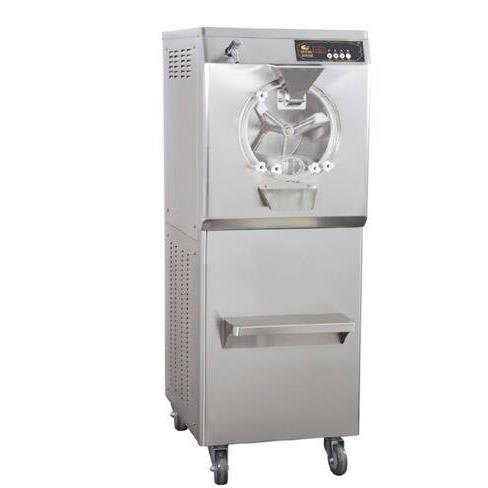
Batch Freezer Upgrade
→ Enabled larger batch production
→ Increased total output per cycle
→ Delivered more consistent ice cream texture
→ Improved operational efficiency
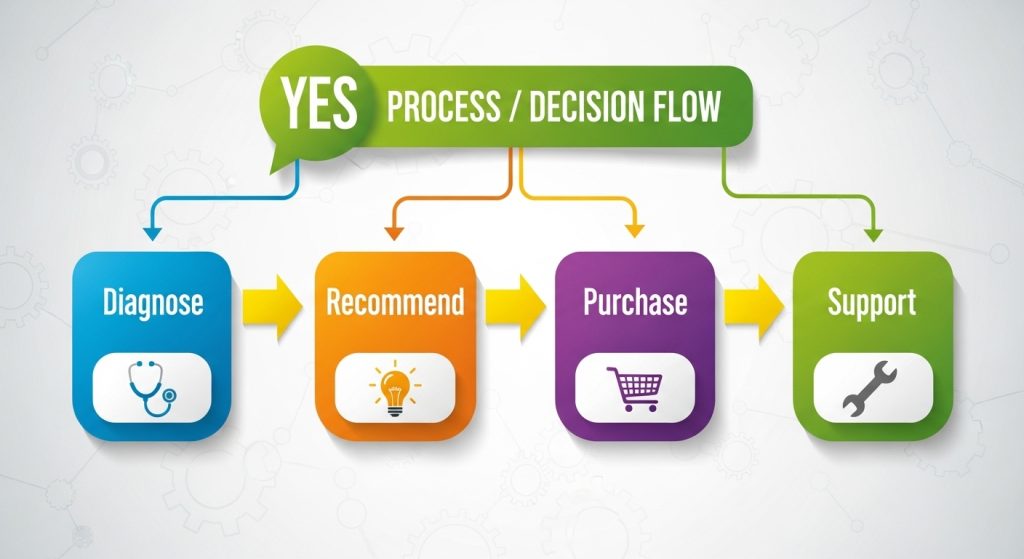
What YES Added:
✔ Equipment matching to production needs
✔ Practical guidance and support
✔ Confidence in performance and reliability
✔ Customer support and communication
✔Ongoing assistance when questions came up
Not just a machine; a production upgrade.
6. Results: Operational & Business Impact
1. Higher Production Capacity
The new batch freezer allowed A&Js to produce larger quantities per cycle, directly increasing supply.
Impact:
- More product available per batch
- Increased ability to meet customer demand
- Better readiness for larger orders
- Reduced risk of production falling behind sales
2. Approximately 3× Faster Production
The upgraded machine improved production speed significantly.
Impact:
- Less time spent repeating smaller batches
- Faster production turnaround
- Improved workflow efficiency
- More production capacity without simply adding more labour
3. Improved Product Consistency
The upgraded batch freezer helped improve the consistency of the finished ice cream compared to the previous equipment.
Impact
Better texture across batches
More reliable product quality
Improved customer experience
Stronger repeat purchase potential
In food production, consistency is not a luxury.
Consistency is what allows customers to trust the brand.
4. Reduced Operational Strain
Larger batches reduced the pressure created by repeated small-batch production.
Impact
Smoother production workflow
Less production pressure
Better use of labour time
Improved ability to plan production
This is where equipment begins to affect the entire operation, not just the product.
This created a referral loop:
Good product → Customer feedback → Increased Revenue & Customer Base
ROI Example: Labour Recovery
The financial value of the upgrade can be understood through recovered production time.
In this case, production work involved 2 people, with each person’s labour valued at TTD $30 per hour.
That means the combined labour value was:
TTD $60 per hour
The larger batch freezer helped reduce repeated production work and recover approximately 4 production hours per day.
Because 2 people were involved, this represents 8 labour-hours recovered per day.
TIME SAVED8 HOURS / DAY REGAINEDProduction is now 3× faster per batch → Same output achieved in significantly less time 8 hrs/day × 5 days = 40 hrs/week saved |
WEEKLY VALUE (LABOUR EFFICIENCY)Valued @ TTD 30/hr 40 hrs × 30 = TTD $1,200/week saved |
YEARLY IMPACTTTD 1,200/week × 52 = TTD 62,400/year in recovered time value |
PAYBACK CALCULATIONInvestment: ROI Year 1: |
***These figures are used as an example only***
Estimated First-Year Payback
208% Operational Payback in One Year
The recovered labour value alone could exceed the original machine investment by more than double within the first year.
And that still does not include the full business upside.
This ROI example does not include:
additional sales potential
ability to produce more product
larger order fulfillment
improved customer retention
reduced production stress
improved consistency
better readiness for wholesale, events, or wider distribution
less pressure on owners and staff during production
For many growing food businesses, the biggest return comes from removing the bottleneck that was limiting growth.
Market Validation
A&J’s improved production capacity did not only help internally.
Customers who tried the product reported:
high quality
strong consistency
increased interest in similar equipment
This created a valuable referral loop:
Better production → Better product consistency → Stronger customer feedback → Increased equipment interest
That is important because it shows how the right production system can strengthen both the business and the brand.
7. What Would Have Happened Without the Equipment?
Without upgrading, A&J’s Premium Ice Cream would likely have continued facing the same production constraints:
- limited batch output
- slower production
- higher production strain
- consistency challenges
- restricted ability to meet demand
- slower growth
Equipment transformed the operation from small-batch production to high-output ice cream processing.
That is the danger for many food businesses.
Demand grows, but the system underneath the business does not.
8. Customer Testimonial
“The batch freezer made a real difference for us. We’re now able to produce larger quantities much more efficiently, and the consistency of the ice cream has improved compared to what we were using before. It’s been reliable, easy to work with, and we’ve had no issues since upgrading.”
June Henry, Co-owner | A&J’s Premium Ice Cream
Why This Matters for Other Business Owners
A&J’s story reflects a common issue across Trinidad & Tobago and the wider Caribbean.
Many small food producers are not limited by ambition.
They are limited by production infrastructure.
As businesses grow, the pressure usually shows up in the same places:
- not enough output
- too much manual effort
- inconsistent batches
- longer production hours
- difficulty keeping up with demand
- stress during peak periods
- missed sales opportunities
At that stage, business owners have a choice.
They can continue pushing harder inside the same limited system.
Or they can upgrade the system.
A&J’s Premium Ice Cream chose to upgrade the system.
The Bigger Business Lesson
Growth exposes bottlenecks.
For agricultural businesses, those bottlenecks usually appear in workflow, handling, grading, and operational efficiency first.
A business can have strong demand, loyal customers, and quality products, but if the operational system remains too manual, growth eventually becomes harder to sustain.
Benzo Poultry Farms shows what happens when a business invests in operational infrastructure before the bottleneck becomes a larger problem.
The result was:
- approximately 5× faster processing
- improved egg grading consistency
- enhanced egg quality presentation
- smoother workflow organization
- easier separation and selling according to egg sizes
- reduced manual labour strain
- major labour recovery
- improved storage and handling efficiency
- approximately 2× operational expansion
- stronger ability to support larger production volumes
That is what operational scaling looks like in modern agricultural production.
10. Why YES Wins
Other suppliers sell machines.
YES sells outcomes.
Typical Seller | YES |
| “Here’s the machine.” | “Here’s your bottleneck removed.” |
| Price-based | ROI-based |
| Transactional | Partnership + support |
| Equipment Only | Equipment+ Guidance + Results |
| Generic Recommendations | Production-matched solutions |
Final Takeaway
A&J’s Premium Ice Cream did not simply buy a larger batch freezer.
They upgraded their production capacity.
They improved consistency.
They reduced production strain.
They recovered valuable labour time.
They created more room for growth.
For business owners, the lesson is simple:
Growth is not only about getting more customers.
Growth requires the infrastructure to serve them.
If your business is already seeing demand but struggling to produce enough consistently, the issue may not be marketing.
It may be production capacity.
At YES, we help businesses identify the operational gaps holding back growth and match them with equipment designed for their actual production needs.
Stop producing in limits. Start producing at scale.
Book a consult: Right Machine. Right Outcome. Zero Guesswork.


