

Client Snapshot
From dependency to full production control in 12 months
Business: Kino’s Meat & Seafood
Owner: Akeeno Alleyne
Location: Tobago
Operation Type: Solo operator: fresh & smoked meat processor
YES Equipment:
1. BEFORE → AFTER TRANSFORMATION
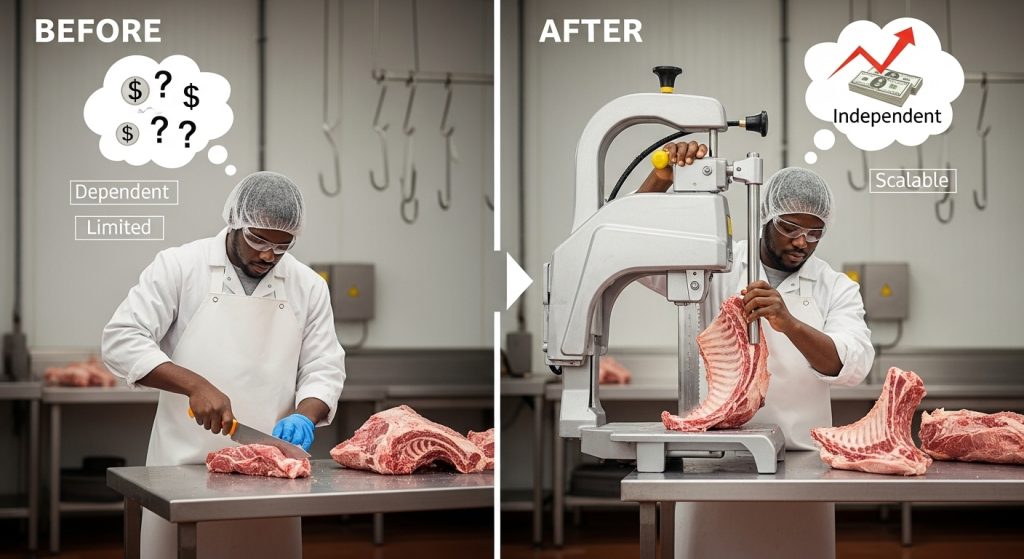
THE PROBLEM (BEFORE): DEPENDENCY MODE
Aspect | Description |
| Reliance | Relied on someone else to cut the meat |
| Time Delay | Waited on availability |
| Cost | Paid weekly for cutting |
| Control | No control over output |
Key Pain Metric
Metric | Impact |
| Hours Lost Per Week | 25 |
The bottleneck wasn’t demand.
The bottleneck was access to a machine.
BEFORE vs AFTER (CORE COMPARISON)
BEFORE | AFTER |
| Outsourced cutting | In-house Cutting |
| 25 hrs/week lost | One-time investment |
| Cost | Paid weekly for cutting |
| Control | No control over output |
2. Market Context: Why This Upgrade Matters
The meat and poultry industry remains one of the most important parts of food production in Trinidad & Tobago and the wider Caribbean.
The global meat processing equipment market is projected to grow from:
USD 12.5 billion in 2024 to USD 20.4 billion by 2033.
At the regional level:
- Latin America & the Caribbean account for approximately 18% of global meat production
- Chicken represents nearly 80% of all meat consumed in the Caribbean
In Trinidad & Tobago specifically:
- Approximately 1 million chickens are consumed weekly
- Around 8 out of every 10 chickens consumed are sourced locally
- The country produces an estimated 42 million chickens annually
At the same time, Trinidad & Tobago still imports significant amounts of poultry and processed meat products:
- In 2024 alone, Trinidad & Tobago imported approximately USD 32.2 million in poultry meat products
This matters because growing demand creates opportunity, but opportunity alone does not build a scalable food system.
The real question becomes:
Can local businesses process enough product efficiently and consistently to meet demand?
That is where equipment becomes more than an operational purchase.
It becomes an economic and food-security decision.
For businesses like Kino’s Meat & Seafood, investing in processing equipment helps:
- increase local processing capacity
- reduce dependence on imported processed products
- improve supply consistency
- keep more money circulating within the local economy
- strengthen regional food security
When local processors grow:
- more spending stays within Trinidad & Tobago
- more money flows into local labour, seasoning suppliers, packaging companies, transport providers, and retailers
- less foreign exchange leaves the country through imported processed foods
This is especially important for Caribbean nations, where food import dependence remains high and global supply chain disruptions can directly affect food availability and pricing.
Food security is not only about farming.
It is also about the ability to process, package, and distribute food locally and reliably.
For growing meat processors, the right equipment helps transform small operations into scalable businesses capable of supporting both the local economy and regional food resilience.
3. Business Context (YES Strategic POV)
Most micro-food processors in the Caribbean struggle with the same issue:
“I know what needs to get done.
I just don’t have the equipment to do it.”
Like many small operators:
- Akeeno ran every part of the business himself.
- He depended on someone else’s machine.
Growth was blocked by dependency, not lack of demand.
YES stepped in with what makes us different:
Right Machine. Right Outcome. Zero Guesswork.
We don’t sell machines; we eliminate bottlenecks.
4. The Bottleneck: Before YES
Challenge | Consequence |
| Outsourced cutting | Output controlled by someone else’s schedule |
| No autonomy | Couldn’t plan production or scale smoked meats |
| Ongoing Cost | 25 hours per week lost in waiting or manual work |
| No consistency | Cut thickness depended on whoever handled the saw |
THE SOLUTION (YES STRATEGY)
YES did not push the most expensive items,
Instead, we opted for the ones that would directly solve any issues he had.
Phase | Machine | Outcome |
| Phase 1 | Table Bone Saw | Eliminate outsourcing |
| Phase 2 | Floor Model Bone Saw | Scale output & consistency |
What YES Added:
✔ Equipment matching
✔ Usage guidance
✔ Safety + cleaning best practices
Right machine. Right sequence. Right outcome.
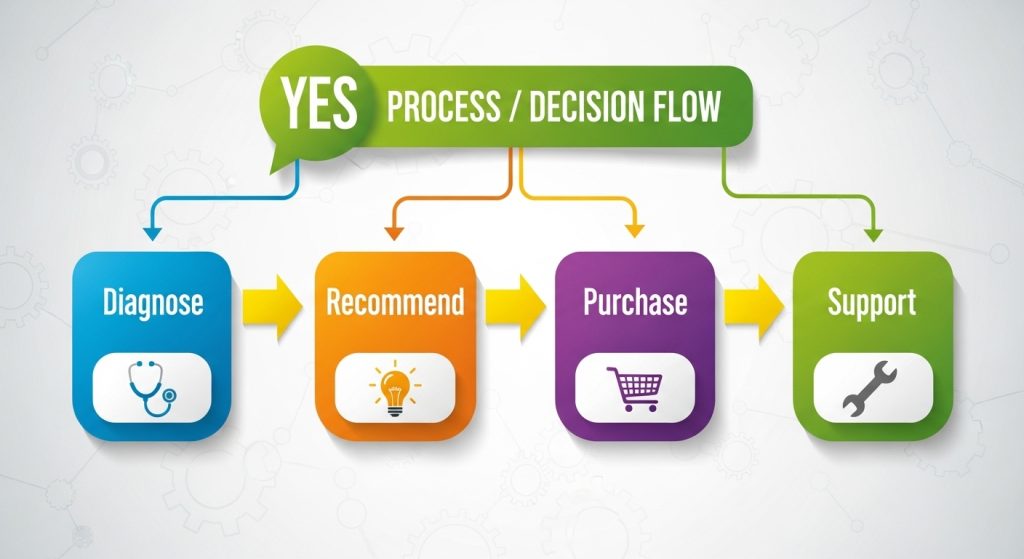
5. YES Recommendation (Strategic + Phased Approach)
Unlike suppliers who push the most expensive equipment, YES sequenced his investment strategically:
Phase 1: Starter machine
Entry-Level Tabletop Bone Saw
→ Objective: regain control + eliminate outsourcing
Phase 2: Scale upgrade (after ROI proven)
Heavy-Duty Floor Model Bone Saw
→ Trigger: demand was now exceeding capacity
6. Results: Financial & Operational ROI
1. Full Production Control
Before purchasing the bone saw, Kino’s Meat & Seafood depended on someone else’s equipment to process meat.
Impact:
- Cutting could now be done in-house
- Production no longer depended on another person’s schedule
- Improved ability to plan workflow and fulfil orders
- Greater control over quality and consistency
2. 25 Hours Recovered Per Week
Owning the machine eliminated significant waiting and outsourced processing time.
Impact:
- More time available for processing and packaging
- Faster overall workflow
- Better use of working hours
- More productive output without increasing staff
3. Improved Product Consistency
The bone saw helped improve consistency across cuts compared to outsourced processing.
Impact:
- More uniform cuts
- Better presentation and product quality
- More reliable output for customers
- Stronger customer confidence in the product
4. Reduced Operational Pressure
The machine reduced the daily stress caused by relying on external processing.
Impact:
- Smoother workflow
- Less production bottlenecks
- Better scheduling flexibility
- Improved ability to scale smoked meat production
ROI Example: Labour Recovery
The financial value of the investment can be understood through recovered production time.
The machine helped recover approximately:
25 production hours per week
Labour value estimated at:
TTD $22.50 per hour
TIME SAVED25 HOURS / WEEK REGAINED5 hrs/day × 5 days = 25 hrs/week |
YEARLY IMPACTTTD 562.50/week x 52 = TTD 29, 250 yearly savings |
PAYBACK CALCULATIONInvestment: ROI Year 1: |
After year one, the machine keeps paying him forever.
Estimated First-Year Payback
101% Operational Payback in One Year
The recovered labour value alone was enough to fully offset the machine investment within the first year.
And that still does not include the full business upside.
This ROI example does not include:
- additional production capacity
- ability to process more meat consistently
- increased smoked meat output
- faster order turnaround
- improved workflow efficiency
- Reduced dependency on outsourced cutting
- improved product consistency
- better readiness for larger orders or expansion
- less operational stress during production
Market Validation
The impact was not only operational.
The improved workflow and consistency also strengthened the customer experience.
Customers benefited from:
- more consistent product quality
- improved availability
- smoother production turnaround
This created a valuable business cycle:
Better workflow → Better consistency → Better customer experience → Stronger business growth potential
That matters because the right equipment does more than improve production.
7. What Would Have Happened Without the Machine?
- Continued dependence on an external cutter
- Continued weekly payout (no end in sight)
- No expansion into smoked products
No regained hours to produce, package, or sell
Without equipment, the business would have remained trapped in dependency.
8. Customer Testimonial
“Recently purchased a bone saw from an equipment supplier in Trinidad, and I couldn’t be happier with the quality and performance. As the owner of a busy meat shop in Tobago, efficiency and precision are key, and this tool has definitely exceeded my expectations. The saw makes cutting through even the toughest bones quick and easy, allowing me to provide my customers with fresh, high-quality cuts every time.
My shop has seen an improvement in workflow, and I’m grateful for the reliable service and top-notch equipment. Highly recommend to any fellow business owners.”
Akeeno Alleyne, Kino’s Meat & Seafood Products
Long-Term Value: What the Investment Continues to Return
The ROI calculation only measures the first year of recovered labour value.
The real advantage is what happens after the machine has already paid for itself.
Once the investment is recovered, the business continues benefiting from:
- reduced outsourcing costs
- recovered production time
- improved workflow efficiency
- greater production control
- better consistency
- increased production capacity
Unlike a recurring labour expense, the machine continues creating value year after year.
Annual Time Recovery
Total Time Recovered Per Year
25 hours/week × 52 weeks
1,300 HOURS RECOVERED PER YEAR
That equals approximately:
- 162 full 8-hour workdays
- over 5 months of working time recovered annually
Financial Value Recovered Annually
TTD 562.50/week × 52 weeks
TTD 29,250 RECOVERED PER YEAR
And that recovery continues beyond Year 1.
What Can Be Done With 1,300 Extra Hours?
Those hours are no longer spent waiting on someone else’s schedule or struggling through production bottlenecks.
That recovered time can now go toward:
- spending more time with his wife and family
- being able to relax more instead of constantly rushing production
- reading, resting, or simply decompressing after work
- spending more time with friends
- taking weekends or evenings back
- attending events or social gatherings without production stress
- focusing on growing the business strategically instead of constantly firefighting operations
- improving overall quality of life and reducing burnout
Sometimes the biggest benefit of equipment is not just productivity.
It is getting your life back.
What Can TTD 29,250 Per Year Help Fund?
Instead of continuously paying outsourced processing costs, the recovered value can now go toward:
- taking trips or vacations
- enjoying more experiences with family and friends
- occasionally splurging on things he genuinely wants
- improving his home or personal lifestyle
- reinvesting into the business when needed
- creating more financial breathing room during slower periods
- reducing stress around everyday expenses
The money no longer disappears into recurring outsourcing costs.
It becomes usable value that can improve both the business and personal life.
The Bigger Business Shift
Before the investment:
- time was being lost
- workflow was restricted
- production depended on outside availability
After the investment:
- production became controllable
- workflow became more efficient
- growth became more achievable
The machine did not simply save money.
It created more usable time, more operational flexibility, and more room for growth.
10. Why YES Wins
Other suppliers sell machines.
YES sells outcomes.
Typical Seller | YES |
| “Here’s the machine.” | “Here’s your bottleneck removed.” |
| Price-based | ROI-based |
| Transactional | Partnership + support |
| Machine | Machine + Guidance + Results |
Stop renting labour. Start owning output.
Book a consult: Right Machine. Right Outcome. Zero Guesswork.


