

Client Snapshot
From manual egg handling to a faster, more scalable production system.
Business: Benzo Poultry Farms
Owner: Reuben Ali
Location: Based in Sangre Grande, supplying customers nationwide
Operation Type: Egg Production
1. The Reality Before Automation
Benzo’s Poultry Farms didn’t struggle because there wasn’t a demand for their eggs; they struggled because of operational strain.
For years, the business relied heavily on manual egg grading, handling, sorting, organising, and storage management. Eggs were weighed individually using a scale, with each egg handled one at a time. As production increased, the physical workload increased with it. Every tray moved manually. Every egg is sorted manually. Every repetitive movement added pressure to the people operating the business daily.
Like many agricultural businesses across Trinidad & Tobago, the operation grew through hard work long before automation entered the picture. But eventually, manual systems become bottlenecks, not only for production, but for people.
According to founder Reuben Ali, years of repetitive manual grading and handling created significant strain on his hands and joints. He explained that the repetitive nature of the work affected his ability to comfortably perform everyday tasks and contributed to ongoing physical discomfort. At one point, he explained that he could barely hold a cup properly because of the physical wear caused by years of repetitive grading work.
That is the hidden reality behind many family-run agricultural businesses.
The cost of manual operations is not only time. It is physical wear, fatigue, operational stress, and dependency on labour-heavy systems that become harder to sustain over time.
And in a family-run operation, those pressures affect everyone. Even the youngest member of the internal team, the farm’s unofficial “happiness specialist,” only three years old, benefits from a business system that creates more stability, less stress, and more recovered time for the family behind the operation.
Because machines can be replaced.
Your joints cannot (at least not legally).
2. BEFORE → AFTER TRANSFORMATION
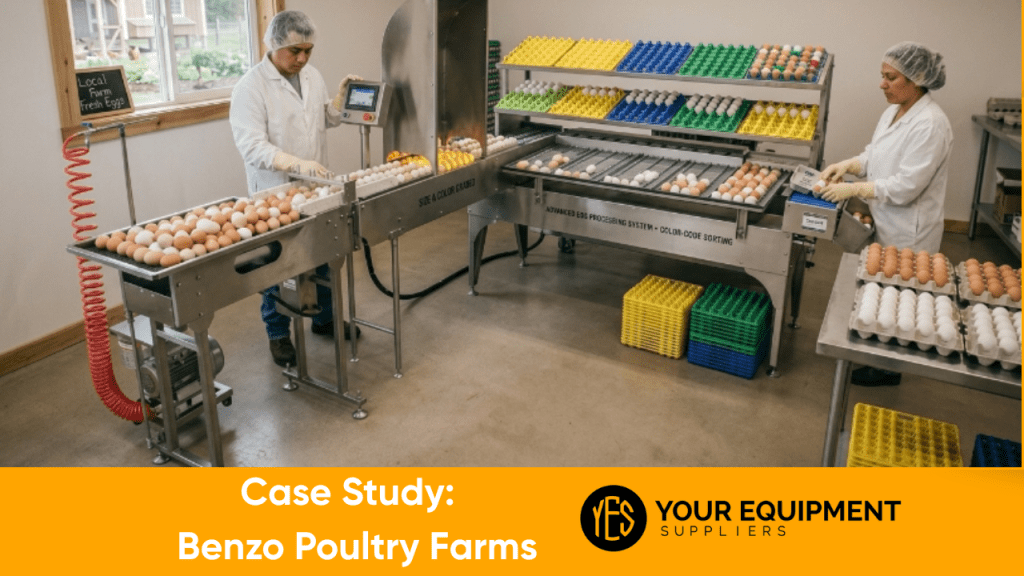
The egg grading system, storage racks, and egg crate trays became the operational upgrade that transformed workflow efficiency.
THE PROBLEM (BEFORE): MANUAL PROCESSING MODE
Benzo Poultry Farms was growing, but the operation was still heavily dependent on manual handling, sorting, and storage management.
Sorting, grading, organizing, storing, and managing eggs manually created production strain, slowed operations, and limited the farm’s ability to scale efficiently.
The transition to an automated egg grading system, combined with improved storage infrastructure and handling systems, helped move the business from labour-intensive manual handling into a faster, more organised, and scalable production process.
| BEFORE (Manual + Slower) | AFTER (Automated + Efficient) |
|---|---|
| Production time 8 hours | Approximately 3x faster egg grading and processing, taking 2-3 hours |
| Egg handling workflow | Automated grading and sorting system |
| Product organisation | Structured storage and handling system |
| Product quality | Improved egg presentation and grading consistency |
| Workflow | Reduced manual strain and repetitive handling |
| Labour recovery | Estimated 30 labour-hours recovered per week (5-6 hours per production cycle saved) |
| Annual recovered labour value | Example estimate of TTD $70,200 per year based on 2 person’s labour valued at TTD $30/hour |
| Egg sales process | Easier to separate and sell eggs according to sizes |
| Storage workflow | Improved organization using industrial shelving and egg trays |
| Business capacity | Increased ability to handle larger production volumes |
| Business growth | Expanded operations by approximately 2× after automation |
3. Market Context: Why This Upgrade Matters
Eggs remain one of the most consumed and affordable protein sources globally, and demand continues increasing as food prices rise worldwide.
At the same time, poultry producers continue facing pressure from rising feed costs, labour costs, and supply chain disruptions.
The global egg industry was valued at over US$250 billion in 2024 and is projected to continue growing steadily, with over 20% growth over the next decade.
This matters because growing demand creates opportunity, but opportunity alone does not create a scalable business.
For local poultry producers, the real question becomes:
Can the operation scale efficiently enough to meet demand sustainably?
That is where operational infrastructure matters.
Businesses like Benzo Poultry Farms help support local food production, agricultural employment, national food security, and more stable egg supply within Trinidad & Tobago.
As local production becomes more efficient and scalable, consumers benefit through more reliable supply, stronger distribution, and improved long-term production stability.
4. The Business Problem: Manual Operations Were Limiting Growth
Many growing agricultural businesses struggle because manual systems eventually become bottlenecks.
For Benzo Poultry Farms, egg production was growing, but the grading, handling, and storage process remained heavily manual. As production volumes increased, Reuben recognised that the manual process could not efficiently support future growth. Having operated the business for several years, he understood that continuing to rely on manual grading and handling would eventually limit expansion. Positive feedback from another business owner who had previously purchased equipment from YES also helped reinforce his decision to invest.
The demand and customers existed.
The challenge was operational efficiency.
The previous setup created limitations such as:
- slower manual grading
- repetitive handling
- increased labour strain
- more time required to process eggs
- difficulty organising eggs efficiently by size
- inefficient storage workflow
- workflow inefficiencies
- operational limitations that slowed expansion
- manual weighing of individual eggs
- difficulty identifying cracked or damaged eggs efficiently
The business had reached the point where manual handling and workflow were no longer aligned with the next stage of growth.
5. The Bottleneck: Manual Egg Handling & Organisation
Before the upgrade, Benzo Poultry Farms faced a common operational bottleneck.
The issue was not demand.
The issue was the amount of manual labour required to process, organize, and manage eggs efficiently.
| Challenge | Consequence |
|---|---|
| Manual grading process | Slower production workflow |
| Repetitive egg handling | Increased labour strain |
| Slower sorting | Reduced operational efficiency |
| Difficulty separating sizes consistently | Harder to optimize egg sales |
| Limited storage organization | Slower handling and movement |
| Labour-intensive workflow | Limited scalability |
| Operational inefficiencies | Slower business expansion |
For agricultural operations, this is often the stage where growth starts creating pressure instead of opportunity.
As output increases, manual systems become harder to sustain.
That is when automation stops being an expense and becomes an operational growth decision.
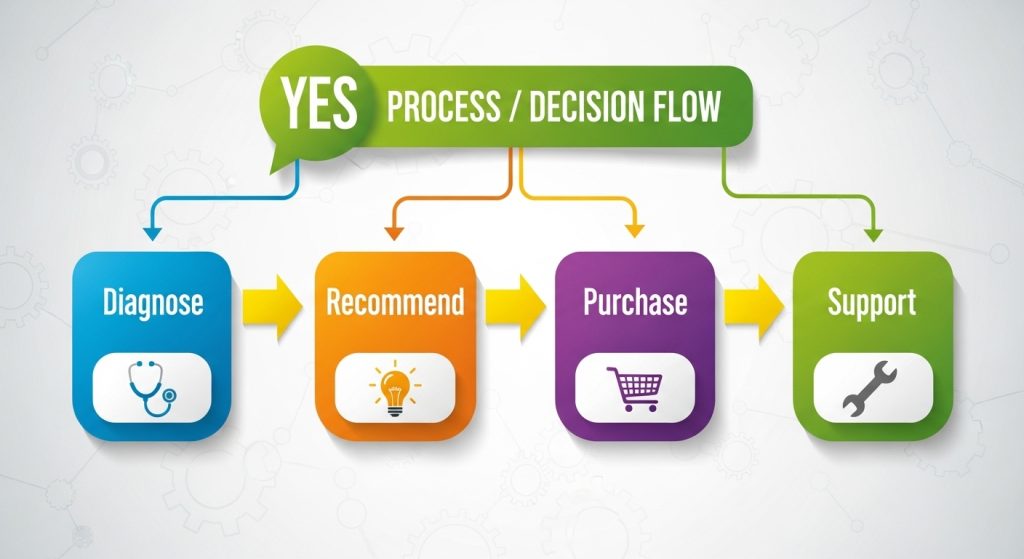
6. YES Recommendation
THE SOLUTION
Egg Grading & Storage Workflow Upgrade
By this stage, the farm had outgrown its manual grading process. Increasing production volumes required a more efficient system, and recommendations from another equipment user gave Reuben additional confidence to move forward with the investment. Instead of continuing with labour-heavy manual processing, the focus was clear:
YES recommended an automated egg grading machine system combined with improved storage and handling infrastructure.
Increase Speed. Improve Egg Quality. Reduce Manual Strain.
The upgrade allowed Benzo Poultry Farms to:
- process eggs significantly faster
- automate grading and sorting
- improve identification of cracked, broken, or spoiled eggs
- improve egg presentation and quality consistency
- reduce repetitive manual labour
- organise eggs more efficiently
- separate eggs according to size more easily
- improve storage workflow
- improve workflow efficiency
- support operational expansion
This was not simply about adding machinery.
It was about building a production system capable of supporting a growing poultry operation.
Egg Grading Machine System
→ Enabled automated grading and sorting
→ Increased processing speed significantly
→ Improved consistency and egg quality
→ Reduced manual handling strain
→ Supported operational expansion


Industrial Shelving & Egg Crate Trays
→ Improved organisation of egg inventory
→ Reduced clutter and handling inefficiencies
→ Made storage and movement more efficient
→ Improved workflow during sorting and packing
→ Helped support larger production volumes more effectively
What YES Added:
✔ Equipment matching to production needs
✔ Practical guidance and support
✔ Confidence in performance and reliability
✔ Customer support and communication
✔Ongoing assistance when questions came up
Not just equipment; an operational upgrade.
7. Results: Operational & Business Impact
1. Reduced Processing Time Significantly
The automated grading system dramatically improved production speed.
Impact:
- Faster egg grading and handling
- Reduced time spent on manual sorting
- Improved operational workflow
- Greater output capacity without simply increasing labour
- Faster turnaround during production cycles
2. Improved Egg Quality & Presentation
The grading system helped improve the consistency and presentation quality of eggs.
Impact
- Better grading consistency
- Enhanced egg presentation
- Improved customer confidence
- Stronger product quality standards
- Easier quality control during processing
In food production, consistency improves trust, and trust improves repeat business.
3. Easier Size Separation & Selling
Before automation, separating eggs according to size required far more manual effort. The automated system made the grading process significantly easier and more organised.
Impact
- Easier separation of egg sizes
- More organised inventory handling
- Improved sales organization
- Better ability to supply customers according to sizing requirements
- Improved efficiency during packing and distribution
4. Improved Storage & Workflow Organisation
The industrial shelving and heavy-duty egg trays improved operational organisation across the farm.
Impact
- Better egg storage organisation
- Easier movement and handling of inventory
- Reduced clutter and workflow congestion
- Faster packing and distribution preparation
- Improved operational efficiency throughout the production process
5. Reduced Operational Strain
The operation previously depended heavily on manual labour.
The automation upgrade reduced repetitive physical handling and improved the overall workflow.
Impact
- Less repetitive manual work
- Reduced labour strain
- Smoother production workflow
- Better use of labour time
- Improved operational organisation
6. Business Expansion After Automation
The improved workflow and faster processing created additional operational capacity. This allowed Benzo Poultry Farms to expand operations by twice the amount after implementing automation.
Impact
- Production capacity increased from approximately 4,000–5,000 eggs to approximately 10,000 eggs.
- Greater ability to scale operations
- Improved readiness for higher production volumes
- Better workflow organization
- Stronger operational foundation for future growth
- Increased efficiency across the business
7. Improved Defect Detection
Impact:
- Easier identification of damaged eggs
- Improved quality control
- Reduced risk of defective products reaching customers
- Improved product consistency
For example purposes only:
If the business was previously generating approximately TTD $50,000 in production-related output or revenue capacity, doubling operational capacity could potentially support approximately TTD $100,000 after expansion.
These figures are examples only and are used for illustration purposes based on operational scaling assumptions.
ROI Example: Labour Recovery + Expanded Production
The financial impact of the automation can be understood through both:
- recovered labour value
- increased production capacity after expansion
In this example scenario, labour was valued at TTD $30 per hour for 2 persons.
The automation upgrade helped recover approximately 30 labour-hours per week while also supporting approximately 2× operational expansion.
TIME SAVED12 HOURS / DAY REGAINEDProduction and grading are now approximately 5× faster. → More eggs processed in significantly less time 12 hrs/day × 5 days = 60 hrs/week saved | ||||||||
WEEKLY VALUE (LABOUR EFFICIENCY)Valued @ TTD 30/hr 60 hrs × 30 = TTD $1800/week saved | ||||||||
YEARLY IMPACTTTD 1800/week × 52 = TTD 93,600/year in recovered time value | ||||||||
PAYBACK CALCULATIONEquipment Investment:TTD $77,590.00 ROI Year 1:93,600 ÷ 77,590 = 120.6% Estimated First-Year Payback120.6% Operational Payback in One Year | ||||||||
EXPANDED PRODUCTION CAPACITYThe improved workflow, faster grading, better organisation, industrial shelving, and egg tray system helped support approximately 2× operational expansion. Example Production IncreasePrevious operational output/value: Estimated output/value after expansion: Increase in Production CapacityTTD $100,000 − TTD $50,000 = TTD $50,000 increase This represents an estimated additional TTD $50,000 in operational growth potential. | ||||||||
COMBINED OPERATIONAL IMPACT
These figures are examples only and are used strictly for illustrative purposes based on operational scaling assumptions. |
Estimated First-Year Operational Impact
Based on these example assumptions, the combined operational impact could exceed TTD $128,000 annually through:
- recovered labour time
- faster processing
- increased production capacity
- smoother workflow
- easier inventory management
- improved egg organization and grading
- operational expansion opportunities
All ROI figures, labour values, production increases, and revenue examples are estimates only and are used strictly for illustrative purposes based on the operational assumptions provided.
Market Validation
Benzo Poultry Farms’ improved operational capacity did not only help internally.
The upgraded grading, storage, and handling system also improved how eggs were presented, organised, and supplied to customers.
Customers and buyers experienced:
- improved egg quality presentation
- more consistent grading and sizing
- better organisation during supply and distribution
- smoother fulfillment capability
- increased confidence in product consistency
The improved workflow also made it easier to supply eggs according to size categories, creating a more professional and efficient sales process.
This created a valuable operational growth loop:
Better workflow → Better grading consistency → Improved customer confidence → Increased operational growth potential
That is important because it shows how the right operational system can strengthen both the business and the customer experience.
For growing agricultural businesses, automation does not only improve internal efficiency.
It improves how the business performs in the market.
8. What Would Have Happened Without the Equipment?
Without automation, Benzo Poultry Farms would likely have continued facing the same operational limitations:
- slower manual grading
- increased labour strain
- repetitive workflow pressure
- slower processing times
- reduced operational efficiency
- difficulty scaling efficiently
- harder organization of egg sizes
- inefficient storage workflow
- slower expansion potential
Automation transformed the operation from manual handling into a more efficient and scalable production system.
That is the challenge many growing agricultural businesses face.
Demand increases, but the operational system underneath the business remains manual.
9. Customer Testimonial
“I have already recommended YES to other business owners and would continue to do so. The team provides good support, communication, and guidance throughout the process. Whenever I have questions or need assistance, they keep me informed and work with me to find solutions. Overall, the experience has been positive, and I would rate their customer service 8.5 out of 10.”
Reuben Ali, Owner | Benzo Poultry Farms
10. Why This Matters for Other Business Owners
Benzo Poultry Farms’ story reflects a common issue across Trinidad & Tobago and the wider Caribbean.
Many growing agricultural businesses are not limited by demand.
They are limited by operational infrastructure.
As production grows, the pressure usually shows up in the same places:
- too much manual labour
- slower workflow
- difficulty organising products efficiently
- increased labour strain
- slower grading and handling
- operational bottlenecks
- difficulty scaling production
- stress during larger production periods
- missed growth opportunities
At that stage, business owners have a choice.
They can continue pushing harder inside the same manual system.
Or they can upgrade the system.
Benzo Poultry Farms chose to upgrade the system.
11. Long-Term Value: What the Investment Continues to Return
The ROI calculation only measures a snapshot of the value created through recovered labour and improved efficiency.
The real advantage is what happens after the equipment has already paid for itself.
Once the investment is recovered, Benzo Poultry Farms continues benefiting from:
- faster grading and sorting
- reduced manual labour requirements
- improved workflow efficiency
- better egg organisation and storage
- easier separation of eggs by size
- improved quality control
- increased production capacity
- reduced physical strain
- greater operational consistency
- improved readiness for future expansion
Unlike labour costs, which continue every week, the equipment continues creating value year after year.
For growing agricultural businesses, the long-term return often extends far beyond the initial investment.
12. Annual Time Recovery
Total Time Recovered Per Year
Using the illustrative example of two workers recovering a combined 60 labour-hours per week:
60 hours/week × 52 weeks
3,120 HOURS RECOVERED PER YEAR
That equals approximately:
- 390 full 8-hour workdays
- more than a year’s worth of working days recovered
- thousands of hours returned to the business annually
- valuable time no longer consumed by repetitive grading, sorting, and handling tasks
Financial Value Recovered Annually
TTD $1,800/week × 52 weeks
TTD $93,600 RECOVERED PER YEAR
And that recovery continues beyond Year 1.
What Can Be Done With 3,120 Extra Hours?
Those hours no longer need to be spent manually weighing, sorting, grading, organising, and handling eggs.
That recovered time can now go toward:
- increasing production volumes
- improving farm operations
- strengthening customer relationships
- improving quality control processes
- expanding distribution channels
- training team members
- planning future business growth
- exploring new opportunities within the poultry industry
- spending more time with his wife and daughter
- attending family events and special occasions
- taking family vacations and weekend trips
- being more present at home instead of constantly working
- getting more rest and reducing physical strain
- enjoying a healthier work-life balance
As Reuben explained, one of the biggest benefits of the grading system was reducing the amount of repetitive manual work required every day.
The improved workflow not only made production faster and more organised, but also reduced operational stress and gave valuable time back to both the business and the family behind it.
Sometimes the biggest benefit of equipment is not simply productivity. It’s creating the freedom to focus on growing the business while having more time to enjoy the people who matter most.
What Can TTD $93,600 Per Year Help Fund?
Instead of being consumed by labour-intensive grading and handling activities, the recovered value can now go toward:
- expanding production capacity
- investing in additional farm equipment
- upgrading storage and handling systems
- improving farm infrastructure
- hiring and training staff
- strengthening distribution capabilities
- improving packaging and product presentation
- creating a stronger financial cushion during slower periods
- reinvesting into long-term business growth
- family vacations and travel
- education and future opportunities for his daughter
- home improvements
- increased financial security for the family
The value no longer disappears into inefficient manual processes. It becomes usable capital that can strengthen both the business and the quality of life of the family behind it.
For many business owners, that is where the real return on investment is found.
12. The Bigger Business Shift
Before the Investment
- Eggs were weighed and handled manually
- Grading and sorting required significant labour
- Production was more time-consuming
- Quality control relied heavily on manual inspection
- Storage and organisation were less efficient
- Growth was increasingly constrained by workflow limitations
- Expansion required more labour and more time
After the Investment
- Egg grading became significantly faster
- Production time was reduced from approximately 8 hours to 2–3 hours
- Quality control improved through easier identification of cracked and damaged eggs
- Storage and organisation became more efficient
- Production capacity increased from approximately 4,000–5,000 eggs to approximately 10,000 eggs
- Workflow became more scalable
- Daily operations became less labour-intensive
- Expansion became more achievable
The equipment did not simply automate egg grading.
It transformed Benzo Poultry Farms from a labour-intensive operation into a more organised, efficient, and scalable production system capable of supporting future growth.
13. Why YES Wins
Other suppliers sell machines.
YES sells outcomes.
Typical Seller | YES |
| “Here’s the machine.” | “Here’s your bottleneck removed.” |
| Price-based | ROI-based |
| Transactional | Partnership + support |
| Equipment Only | Equipment+ Guidance + Results |
| Generic Recommendations | Production-matched solutions |
Final Takeaway
Benzo Poultry Farms did not simply purchase an egg grading machine system. They upgraded the way the entire operation functioned.
The business moved from a heavily manual workflow into a faster, more organised, and scalable production system.
For business owners, the lesson is simple.
- Growth is not only about getting more customers.
- Growth requires the operational infrastructure to support increasing demand efficiently.
A business can have strong sales potential, but if the workflow behind the operation is too manual, growth eventually becomes harder to sustain.
Benzo Poultry Farms invested in operational infrastructure before the bottleneck became a larger problem.The business moved from manually weighing and handling eggs one at a time to a system capable of processing approximately 10,000 eggs while improving grading consistency, quality control, workflow organisation, and production speed.
At YES, we help businesses identify the operational gaps slowing growth and match them with equipment designed for their actual production needs.
Stop producing in limits. Start producing at scale.
Book a consult: Right Machine. Right Outcome. Zero Guesswork.


