

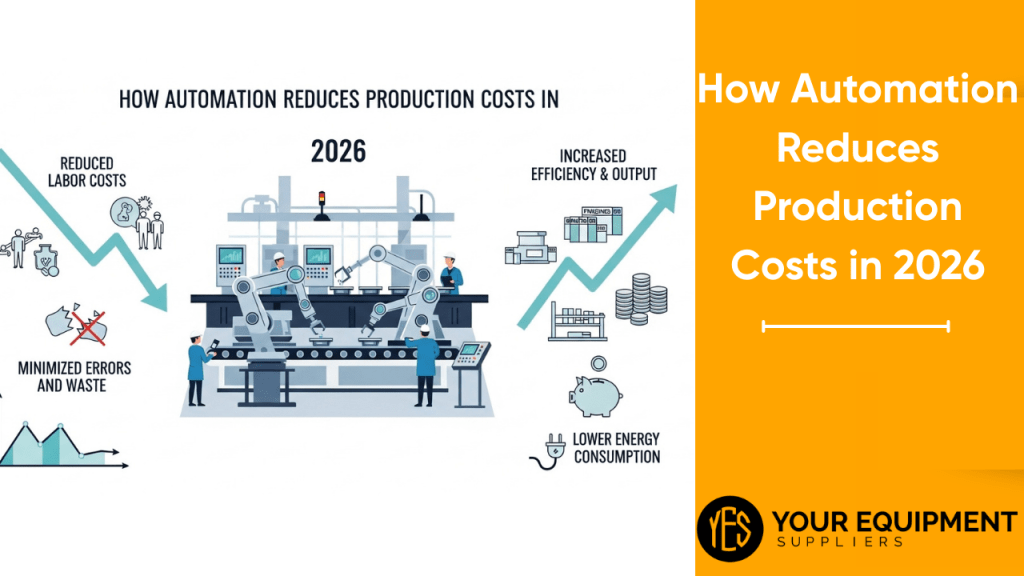
Manufacturing in 2026 feels different.
Margins are thinner. Labour markets are tighter. Energy volatility hasn’t gone away. Customers expect faster turnaround with near-perfect quality. And investors? They want efficiency, not excuses.
Automation isn’t a futuristic upgrade anymore. It’s operational discipline.
Let’s unpack what that actually means.
The Real Cost Problem in 2026
Production costs don’t explode overnight. They erode.
Small inefficiencies compound:
- Minor quality variation
- Manual handling delays
- Unplanned downtime
- Energy waste
- Poor demand forecasting
- Overtime creep
Individually, these seem tolerable. Together, they quietly drain profitability.
In 2026, the competitive advantage isn’t who works harder. It’s who builds systems that remove variability.
Automation is a variability killer.
How Automation Reduces Overall Costs
A mid-sized packaging manufacturer delayed automation for years. Leadership believed their experienced operators were “good enough.” Output was stable. Margins were acceptable.
Then labour turnover increased. Training costs rose. Quality complaints ticked up slightly, nothing dramatic, just enough to trigger customer audits.
They automated one section of the line first: labeling and inspection.
Nothing revolutionary happened. Production didn’t double. Headlines weren’t written.
But rework dropped by 38%. Labour hours per unit fell by 22%. Customer returns declined. And perhaps most importantly, supervisors stopped firefighting and started planning.
The change wasn’t dramatic.
It was structural.
That’s the power of automation done correctly.
1. Labour Efficiency Without Labour Instability
Automation doesn’t eliminate people. It stabilises output.
Robotic arms, automated conveyors, and programmable logic controllers (PLCs) perform repetitive tasks with consistent timing. That reduces:
- Overtime dependency
- Training churn
- Fatigue-related errors
- Shift-to-shift variability
In 2026, labour markets remain unpredictable in many regions. Skilled operators are harder to retain. Automation reduces the risk of disruption.
It allows your team to focus on higher-value oversight instead of repetitive motion.
2. Waste Reduction Through Precision
Manual processes introduce variability. Variability creates waste.
Automated dosing systems, precision filling equipment, and computer-controlled cutting tools dramatically reduce overfill, trimming losses, and scrap rates.
Even a 1–2% material waste reduction can translate into major annual savings in high-volume production environments.
Consistency is profit.
3. Predictive Maintenance Saves Downtime Costs
This is where 2026 automation is significantly more advanced than earlier systems.
Modern automated production lines integrate sensors that monitor vibration, temperature, and output deviation. This data feeds into predictive maintenance systems.
Instead of reacting to breakdowns, you anticipate them.
Unplanned downtime is brutally expensive. It stops production, wastes labour, disrupts scheduling, and strains customer relationships.
Predictive maintenance shifts maintenance from reactive cost centre to strategic cost control.
4. Energy Optimisation
Energy costs remain volatile globally.
Smart automation systems optimise machine cycles, reduce idle power consumption, and balance load usage. Integrated systems can adjust production speeds dynamically based on demand or peak energy pricing.
Energy is often an overlooked cost driver. Automation exposes it.
You can’t optimise what you don’t measure.
5. Improved Quality = Lower Total Cost
Quality errors are hidden cost multipliers.
Defects lead to:
Rework
Scrap
Returns
Reputation damage
Compliance risks
Automated inspection systems using machine vision detect inconsistencies faster than manual inspection. They don’t get tired. They don’t miss shifts.
Fewer defects mean fewer downstream costs.
And in 2026, customers expect traceability. Automated systems log data in real time, creating audit-ready documentation automatically.
Compliance becomes easier. Risk declines.
6. Scalability Without Proportional Cost Increases
Manual operations scale linearly.
More production usually means more labour, more supervision, more training, more mistakes.
Automated systems scale differently.
Once installed, increasing output often requires marginal adjustments rather than proportional hiring.
That’s operational leverage.
The ROI Question
Automation requires capital. That part is unavoidable.
But the real question isn’t “Can we afford automation?”
It’s “Can we afford inefficiency for another five years?”
In 2026, financing options, leasing models, and performance-based supplier partnerships make automation more accessible than ever.
The smartest manufacturers don’t automate everything at once.
They start where:
Waste is highest
Downtime is frequent
Labour volatility is most disruptive
Quality variation impacts revenue
Small strategic automation projects often produce the fastest ROI.
Where Companies Go Wrong
Automation fails when it’s implemented as a vanity project.
Common mistakes include:
Over-automating without process standardisation
Ignoring operator training
Choosing equipment without integration planning
Failing to track measurable cost metrics
Automation is not magic.
It amplifies whatever system it enters. If your process is chaotic, automation makes it faster chaos.
Process clarity comes first.
The Competitive Reality in 2026
Your competitors are not debating whether to automate.
They are debating how fast.
Manufacturers who ignore automation risk:
- Higher cost per unit
- Slower delivery times
- Reduced pricing flexibility
- Lower margins
- Increased operational risk
Meanwhile, automated competitors gain cost advantages that compound annually.
This isn’t hype. It’s arithmetic.
Final Thought
Automation is not about robots replacing people. It’s about systems replacing inefficiency.
In 2026, manufacturing success depends less on effort and more on architecture. Companies that design smarter systems outperform those that rely on heroic labour.
Automation reduces production costs because it removes variability, stabilises output, optimises resources, and creates measurable control. And control is what protects margin.
If you’re evaluating where to begin, focus on the process that causes the most friction today. That friction is likely your most profitable automation opportunity.
The future of manufacturing isn’t louder. It’s cleaner, smarter, and structurally leaner.
Listen to our podcast below for more information.


