

It started with a simple complaint.
A business owner, let’s call him Ravi, stood over his production line with his arms folded, watching three employees struggle to keep up with orders. One machine kept jamming, another needed constant stopping and restarting, and the third… well, nobody really trusted it enough to run at full speed.
“Demand isn’t the problem,” he said. “We just can’t seem to keep up.”
On paper, everything looked fine. Orders were coming in. Staff was showing up. Equipment was “working.”
But in reality, his operation was quietly leaking time, output, and money every single day.
And the frustrating part is this. Most of it came down to a few equipment decisions that felt minor at the time.
If you run any kind of production setup, food, manufacturing, or packaging, there is a good chance you are closer to Ravi’s situation than you think.
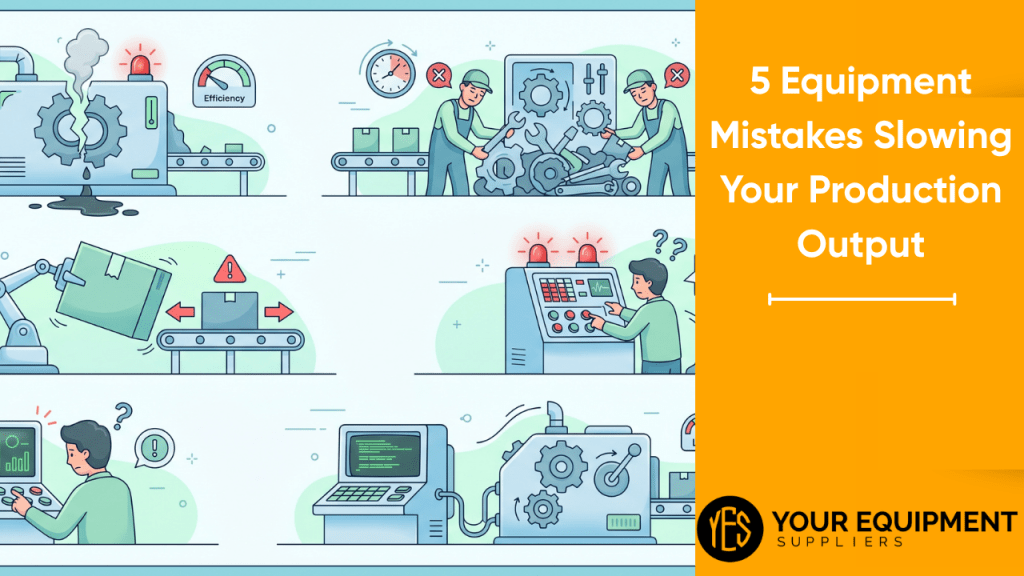
Let’s walk through five common equipment mistakes that slow production down and what they actually cost you.
1. Choosing based on price instead of output
It usually starts here.
You are comparing two machines. One is cheaper, so it feels like the safer choice. Less upfront risk. Easier to justify.
But what often gets ignored is output over time.
A lower cost machine that produces less per hour or needs more downtime ends up costing more in labor, lost orders, and missed opportunities. You are not saving money. You are spreading the cost across inefficiency.
The better question is not “What does this cost?” but “What does this produce per hour consistently?”
If your machine cannot keep up with demand, your business cannot grow past it.
2. Buying equipment that does not match your real demand
A lot of businesses either underbuy or overbuy.
Underbuying is more common. You get a machine that handles your current volume, not where you are heading. Within months, you are already hitting limits. Staff starts working around the machine instead of with it.
Overbuying has its own problems. Larger machines can bring higher energy use, more complexity, and unnecessary capital tied up.
The real issue is not size. It is alignment.
You need equipment that fits your actual production flow, not just peak guesses or current constraints. That means looking at your order patterns, your busiest periods, and your growth plans.
If your equipment cannot scale with you, it will eventually slow you down.
3. Ignoring downtime and maintenance reality
Every machine works perfectly on day one.
The real test is what happens after weeks or months of use.
Some equipment requires frequent cleaning, calibration, or part replacement. Others break down in ways that stop your entire line. If you did not factor this in from the beginning, it shows up later as “unexpected” downtime.
And downtime is expensive in ways people underestimate. It is not just lost production. It is idle staff, delayed deliveries, and sometimes lost customers.
Ask the harder questions upfront.
How often does this machine need maintenance?
How long does it take to service?
Are parts easy to get?
If the answers are unclear, that is already a warning sign.
4. Creating bottlenecks between machines
Even when individual machines perform well, the system can still fail.
One machine produces faster than the next can handle. Another requires manual handling that slows everything down. Suddenly, your entire line is only as fast as its weakest link.
This is where many operations lose output without realizing it.
Production is not about isolated machines. It is about flow.
If your mixing stage is fast but your forming stage is slow, your output is limited. If packaging cannot keep up, finished goods pile up and create delays.
Optimizing production means looking at how everything connects, not just how each piece performs on its own.
5. Delaying upgrades because of cost
This is the mistake that keeps everything else in place.
You know a machine is slowing you down. You see the inefficiencies every day. But replacing or upgrading feels like a big financial step, so it gets pushed aside.
In the meantime, the hidden costs keep stacking.
Lost production hours
Higher labor costs
Missed sales opportunities
Over time, these often exceed the cost of the upgrade itself.
This is where financing changes the conversation.
Instead of asking, “Can we afford this now?” the better question becomes, “How much is it costing us not to?”
When structured properly, financing allows you to increase output first and pay over time using the additional revenue generated.
In other words, the upgrade funds itself through improved performance.
A quick reality check
If any of this feels familiar, it is worth taking a closer look at your setup.
Not from a technical perspective, but from a business one.
Ask yourself:
Where are we losing time in production?
Which machine do we work around the most?
What is currently limiting our output?
The answers usually point directly to the bottleneck.
Case snapshot
One small food production business upgraded a single piece of equipment that had been slowing their line for months.
Before the upgrade, they were producing around 400 units per hour with frequent stops. After replacing the bottleneck machine and balancing the line, output increased to over 900 units per hour.
No additional staff. Same demand.
The difference came from removing one weak point.
Where to go from here
If your goal is to grow, your equipment has to support that growth, not restrict it.
That does not always mean replacing everything. Sometimes it is one strategic upgrade. Sometimes it is rethinking how your current machines work together.
And sometimes, it is simply recognizing that what got you here will not get you to the next level.
If you are planning to scale or feeling the pressure of demand outpacing your production, it might be time to take a serious look at your setup.
Explore your options. Run the numbers. And if upfront cost is the only thing holding you back, look into financing solutions that let you move now instead of later.
Because the longer inefficiencies stay in your system, the more they quietly cost you.
Ready to increase your output without overcomplicating your operation?
Take a closer look at your equipment setup and see where the real constraints are. If you need support upgrading or financing the right solution, now is the time to act.


