

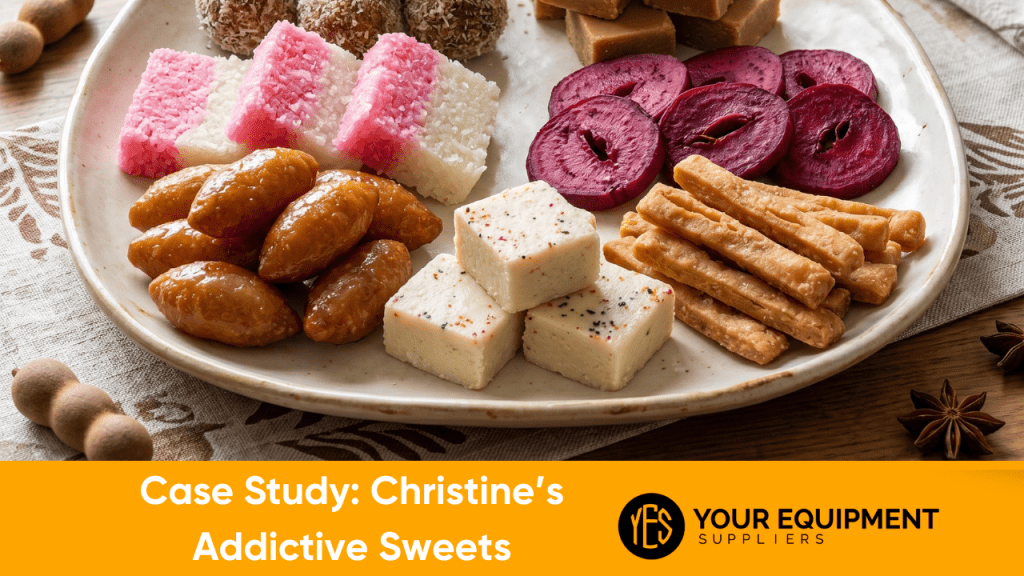
Client Snapshot
From Manual Dough Preparation to Faster, More Scalable Production
Business: Christine’s Addictive Sweets
Owner: Christine Williams
Location: Sangre Grande, Trinidad
Operation Type: Local Treats & Sweets
YES Equipment:
- Dough Sheeter
- Chin Chin Cutter
1. BEFORE → AFTER TRANSFORMATION
The Dough Sheeter and Chin Chin Cutter became the foundation behind Christine’s production improvement.
THE PROBLEM (BEFORE): MANUAL PREPARATION MODE
Christine had built a loyal customer base for her Chin Chin and other sweet treats, but production remained heavily dependent on manual rolling and cutting.
The process was time-consuming, labour-intensive, and limited how much product could be prepared within a given production period.
| BEFORE (Manual + Labour Intensive) | AFTER (Faster + More Efficient) |
|---|---|
| Manual rolling and cutting | Mechanised dough preparation |
| Labour-intensive workflow | Streamlined production process |
| Approximately 12 hours production time | Approximately 6 hours production time |
| Limited batch capacity | Double the batch capacity |
| More time spent on preparation | More time available for other products |
| Greater production strain | Improved workflow efficiency |
| Capacity constrained by manual processing | Greater production flexibility |
2. Market Context: Why This Upgrade Matters
The Caribbean food manufacturing sector continues to create opportunities for producers of traditional snacks and sweets.
According to industry data, the Caribbean packaged food retail market was valued at approximately USD $10.2 billion in 2024, demonstrating the scale of consumer demand across the region.
Within the wider Caribbean, the snack food market alone is estimated at approximately USD $1.2 billion, with continued growth driven by convenience foods, local flavours, tourism, and strong consumer demand for regional products.
Traditional products such as:
- Khurma
- fudge
- sugar cake
- coconut drops
- tamarind balls
- kurma sticks
- nut cakes
remain staples throughout Trinidad & Tobago and the wider Caribbean.
These products are sold through:
- supermarkets
- groceries
- roadside vendors
- schools
- corporate gift programmes
- community events
- online food businesses
This matters because growing demand creates opportunity, but opportunity alone does not create a scalable business.
For local snack manufacturers, the real question is:
Can the business produce enough product consistently to meet demand?
That is where production equipment becomes a growth decision.
Many traditional snack businesses eventually reach a point where manual rolling, cutting, and preparation begin to limit production capacity. As demand grows, the production system must grow with it.
For businesses like Christine’s Addictive Sweets, improving production efficiency creates the foundation needed to support future growth, larger orders, and increased output without proportionally increasing labour requirements.
3. The Business Problem: Production Was Consuming Valuable Time
Many food businesses don’t struggle for lack of customers. It’s usually because their production systems require too much time and effort.
For Christine’s Addictive Sweets, the demand existed, and customers were already purchasing the products, so the challenge was production efficiency.
The previous setup created limitations such as:
- Manual dough preparation
- Labour-intensive rolling and cutting
- Longer production times
- Limited batch capacity
- Less time available for producing additional products
- Greater production strain
The business had reached a point where production efficiency was limiting how much could be accomplished during each production cycle.
4. The Bottleneck: Dough Preparation
Before investing in the Dough Sheeter and Chin Chin Cutter, dough preparation required heavy manual effort. Rolling and cutting dough consumed a large portion of the production process.
Christine estimates that a production cycle that previously required approximately 12 hours can now be completed in roughly 6 hours. At the same time, the equipment allows her to process approximately twice as much product within the same production period.
For many food manufacturers, this is where equipment stops being a purchase and becomes a growth decision.
| Challenge | Consequence |
|---|---|
| Manual rolling | Increased preparation time |
| Manual cutting | Slower production |
| Labour-intensive workflow | Reduced efficiency |
| Time spent on repetitive tasks | Less time for other products |
| Limited batch capacity | Difficulty scaling |
5. YES Recommendation (Strategic Equipment Stack)
THE SOLUTION
Dough Sheeter + Chin Chin Cutter
Instead of continuing with manual preparation, the focus was clear:
Increase Capacity. Reduce Production Time. Improve Workflow.
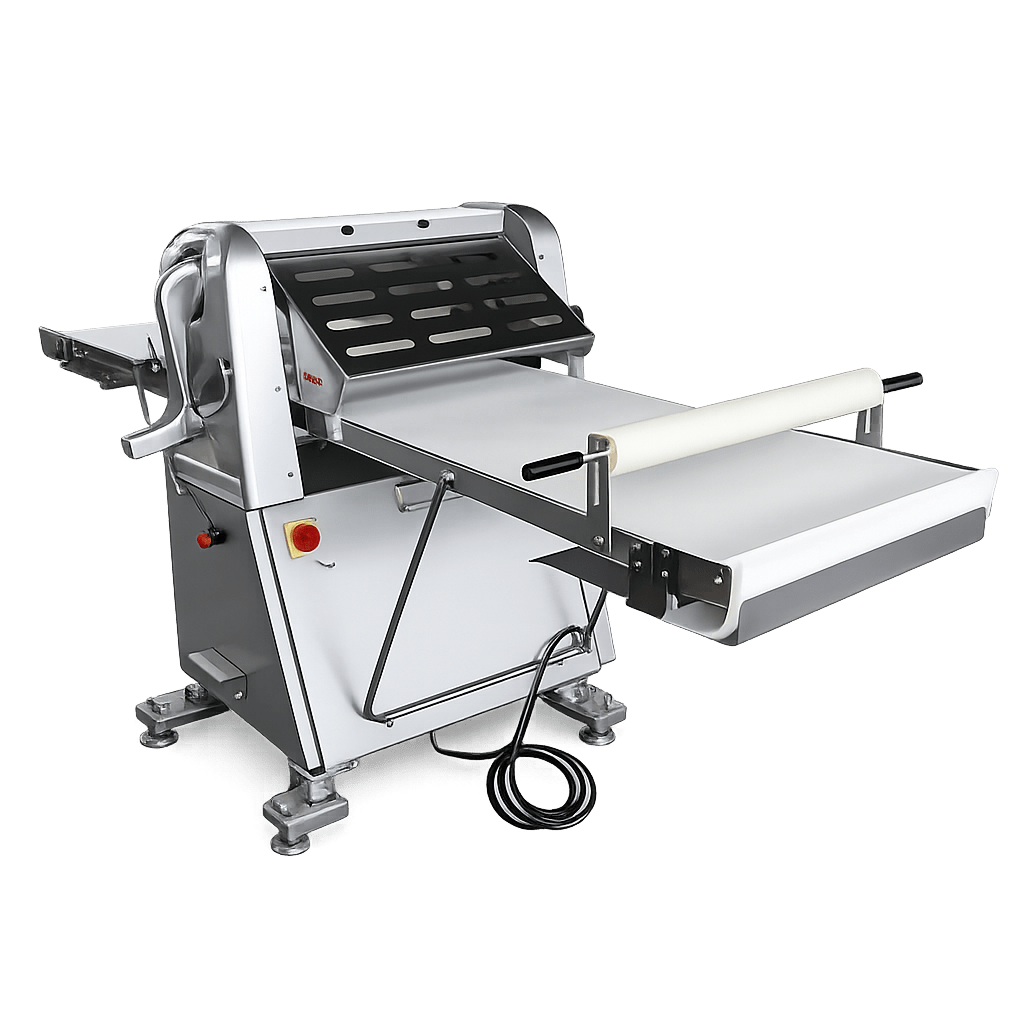
Dough Sheeter
→ Faster dough preparation
→ Reduced manual labour
→ Improved workflow efficiency
→ Consistent dough thickness
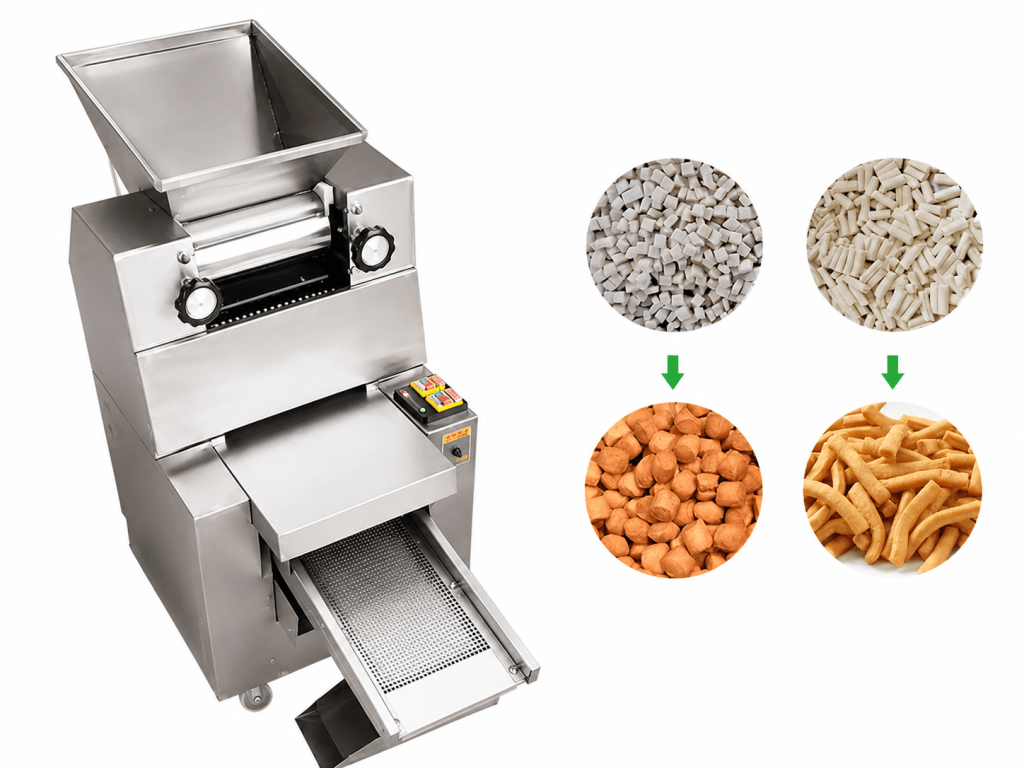
Chin Chin Cutter
→ Faster cutting process
→ Improved consistency
→ Reduced preparation time
→ Greater production efficiency
What YES Added:
✔ Equipment matching to production needs
✔ Practical guidance and support
✔ Confidence in performance and reliability
✔ Customer support and communication
✔Ongoing assistance when questions came up
Not just a machine; a production upgrade.

6. Results: Operational & Business Impact
1. Production Time Reduced by Approximately 50%
The new equipment significantly reduced the amount of time required for dough preparation.
Impact:
- Faster production cycles
- Improved workflow efficiency
- Less time spent on manual preparation
- Better use of available production hours
Customer Quote
“If it used to take eight hours before, now it might just take four or five.”
2. Double the Batch Capacity
The Dough Sheeter and Chin Chin Cutter allow Christine to process significantly more product during production.
Impact:
- Greater production flexibility
- Ability to respond to larger orders
- Increased production capacity
- Improved scalability
Customer Quote
“I could produce a lot more if I needed to.”
3. More Time for Additional Products
By reducing preparation time, Christine can dedicate more time to producing other items.
Impact:
- More time available for fudge production
- More time available for sugar cake production
- Greater product variety
- Better use of production time
Customer Quote
“It gives me time to make other things too, like fudge or sugar cake.”
4. Improved Product Consistency
The Chin Chin Cutter helps create more uniform products.
Impact
- Better consistency
- Improved presentation
- More professional finished products
- Better customer experience
Customer Quote
“It helps with consistency.”
5. Reduced Production Strain
The equipment reduced some of the physical effort involved in production.
Impact
- Less repetitive work
- Improved workflow
- Reduced production pressure
- Better overall production experience
6. Identified the Next Growth Opportunity
The equipment successfully removed one bottleneck and highlighted the next area for improvement.
Impact
- Clearer growth pathway
- Improved production planning
- Future expansion opportunities
Customer Quote
“I need to look into a dough mixer to knead it.”
ROI Example: Labour Recovery
The financial value of the upgrade can be understood through recovered production time.
Christine estimates that the Dough Sheeter and Chin Chin Cutter recover approximately 12 production hours per week.
Using a labour value of TTD $35 per hour:
TIME SAVED12 LABOUR HOURS / WEEK REGAINEDThe equipment reduced the time required for rolling, sheeting, and cutting dough while allowing more product to be processed. WEEKLY VALUE (LABOUR EFFICIENCY)Valued @ TTD 35/hr 12 hrs × 35 = TTD $420/week saved |
YEARLY IMPACT
TTD 420/week × 52 = TTD 21,840/year in recovered time value |
PAYBACK CALCULATIONEquipment InvestmentDough Sheeter: TTD $14,200 Chin Chin Cutter: TTD $22,800 Total InvestmentTTD $37,000 ROI Year 1: |
***These figures are used as an example only***
Estimated First-Year Payback
59% Operational Payback in One Year
The recovered labour value alone offsets a significant portion of the equipment investment during the first year.
However, it is important to note that this example reflects Christine’s current production schedule, where the Dough Sheeter and Chin Chin Cutter are typically used only one to two days per week.
The equipment is therefore not yet being utilised at its maximum production potential.
As production volumes increase, customer demand grows, or additional production days are added, the annual value recovered from the equipment would also increase.
This means the actual long-term return could be substantially higher than the example shown above.
The ROI example also does not include:
- Doubling batch capacity
- Increased production flexibility
- Additional Khurma production
- More time for producing fudge, sugar cake, and other products
- Improved consistency
- Ability to fulfil larger orders
- Reduced production strain
- Future business growth opportunities
For many growing food manufacturers, the biggest return comes from removing the bottleneck that was limiting production.
In Christine’s case, the Dough Sheeter and Chin Chin Cutter not only reduced production time by approximately 50%, but also created the capacity to produce twice as much product whenever demand requires it.
7. What Would Have Happened Without the Equipment?
Without upgrading, Christine’s Addictive Sweets would likely have continued facing the same production constraints:
- Labour-intensive dough preparation
- Longer production times
- Limited batch capacity
- Less time for additional products
- Greater production strain
- Reduced production flexibility
The equipment transformed a labour-intensive preparation process into a more efficient and scalable workflow.
8. Customer Testimonial
“Yes, I would recommend YES because if you don’t want to take a chance buying equipment by yourself, or you don’t have access to a credit card, just go to YES.”
“The service was good.”
Christine Williams, Owner | Christine’s Addictive Sweets
9. Why This Matters for Other Business Owners
Christine’s story reflects a challenge faced by many food manufacturers across Trinidad & Tobago and the wider Caribbean. Many businesses aren’t limited by demand, but by production efficiency.
As businesses grow, pressure often appears in the same areas:
- Too much manual labour
- Long production hours
- Limited production capacity
- Repetitive preparation tasks
- Difficulty increasing output
- Less time for business development
- Increased operational stress
At that stage, business owners have a choice. They can continue working harder within the same production system or they can upgrade the system.
Christine chose to upgrade the system.
10. Long-Term Value: What the Investment Continues to Return
The ROI calculation only measures the first year of recovered labour value. The real advantage is what happens after the equipment has already paid for itself. Once the investment is recovered, Christine’s Addictive Sweets continues benefiting from:
- reduced production time
- larger batch capacity
- improved workflow efficiency
- greater production flexibility
- improved consistency
- reduced manual labour
- more time for additional products
- increased ability to meet customer demand
- improved growth readiness
Unlike labour costs, the equipment continues generating value year after year.
11. Annual Time Recovery
Total Time Recovered Per Year
12 hours/week × 52 weeks
624 HOURS RECOVERED PER YEAR
That equals approximately:
- 78 full 8-hour workdays
- almost 16 working weeks recovered annually
- nearly four months of working time returned every year
Financial Value Recovered Annually
TTD $420/week × 52 weeks
TTD $21,840 RECOVERED PER YEAR
And that recovery continues beyond Year 1.
What Can Be Done With 624 Extra Hours?
Those hours are no longer spent manually rolling and cutting dough.
That recovered time can now go toward:
- producing more Chin Chin
- increasing inventory ahead of peak seasons
- producing more fudge and sugar cake
- developing new products
- improving packaging and branding
- pursuing wholesale opportunities
- strengthening customer relationships
- reducing stress and burnout
- spending more time with family
Sometimes the biggest benefit of equipment isn’t simply producing faster. It’s creating the time and freedom to focus on growing the business instead of constantly working in it.
What Can TTD $21,840 Per Year Help Fund?
Instead of being absorbed by inefficient production processes, the recovered value can now go toward:
- additional equipment investments
- improved packaging
- expanded product lines
- marketing initiatives
- increased inventory production
- business development activities
- future facility improvements
- strengthening cash flow
The value no longer disappears into manual preparation. It becomes capital that can support future growth.
12. The Bigger Business Shift
Before the Investment
- Production relied heavily on manual rolling and cutting
- Dough preparation consumed significant time
- Batch capacity was limited
- Production required greater physical effort
- Less time was available for additional products
- Growth was restricted by production efficiency
After the Investment
- Production time was reduced by approximately 50%
- Batch capacity doubled
- Workflow became more efficient
- More products could be produced within the same working period
- Consistency improved
- Production became more scalable
- More opportunities emerged for future growth
The equipment did not simply save time. It transformed a labour-intensive production process into a more efficient and scalable operation capable of supporting future demand.
13. Why YES Wins
Other suppliers sell machines.
YES sells outcomes.
Typical Seller | YES |
| “Here’s the machine.” | “Here’s your bottleneck removed.” |
| Price-based | ROI-based |
| Transactional | Partnership + support |
| Equipment Only | Equipment+ Guidance + Results |
| Generic Recommendations | Production-matched solutions |
Final Takeaway
Christine’s Addictive Sweets did not simply purchase a Dough Sheeter and Chin Chin Cutter.
The business:
- reduced production time by approximately 50%
- doubled batch capacity
- improved workflow efficiency
- improved product consistency
- recovered approximately 624 production hours annually
- created an estimated TTD $21,840 in annual time value
- freed up time to produce additional products
- created a stronger foundation for future growth
For business owners, the lesson is simple:
- Growth is not only about increasing sales.
- Growth requires the production capacity to support those sales.
If your business is already experiencing demand but struggling with labour-intensive preparation, limited capacity, or inefficient production processes, the issue may not be marketing. It just might be your production system.
For Christine’s Addictive Sweets, the challenge was creating a production process capable of keeping up with future growth.
At YES, we help food manufacturers identify the operational bottlenecks holding back growth and match them with equipment designed around their actual production needs, because the right equipment doesn’t just improve production. It creates the foundation for sustainable growth.
Stop producing in limits. Start producing at scale.
Book a consult: Right Machine. Right Outcome. Zero Guesswork.


