

The Rise of Solar Adoption
Over the past two decades, solar energy has evolved from a niche innovation into a mainstream global movement driving sustainability and self-reliance. What was once viewed as an expensive, experimental technology is now one of the fastest-growing energy sources in the world, reshaping industries, lifestyles, and economies.
Global Shift Toward Renewable Energy
As climate change intensifies and fossil fuels become both costly and environmentally damaging, governments and individuals alike are turning to renewables. Solar power, in particular, stands out due to its scalability, from rooftop panels to portable solar-powered devices like backpacks, lamps, and even wearables. According to the International Energy Agency (IEA), solar energy is now the cheapest source of electricity in many regions.
Technological Advancements Driving Accessibility
Innovation in photovoltaic (PV) cells, lightweight materials, and battery storage has significantly reduced costs while improving performance. Solar panels are now thinner, more flexible, and more efficient, making them suitable not just for large-scale farms but also for consumer gadgets and transport solutions. The integration of solar cells into daily devices has made renewable energy accessible to ordinary people everywhere.
Government Incentives and Green Policies
Subsidies, tax credits, and climate initiatives worldwide are accelerating solar adoption. Nations like China, the United States, India, and members of the EU have all launched large-scale solar programs to reduce carbon emissions and dependency on non-renewable energy sources. These incentives also encourage innovation among manufacturers and startups in the clean-tech space.

Consumer Demand and Lifestyle Shifts
The modern consumer is more eco-conscious than ever. Individuals now look for sustainable options in everything,from energy to fashion. Solar-powered wearables, gadgets, and transport solutions (like e-bikes and camping gear) are gaining traction as people seek to reduce their carbon footprint while staying connected and mobile.
Impact on Developing Economies
In regions without reliable grid access, solar power provides independence and opportunity. Portable solar lights, chargers, and pumps are transforming rural communities, offering education after dark, supporting agriculture, and enabling small businesses. The adoption of solar technology has thus become a powerful driver of economic empowerment and social progress.
The Future of Solar Innovation
The next frontier includes solar integration into urban infrastructure; smart cities, solar roads, electric vehicle charging stations, and wearable energy tech. As battery technology continues to advance, the efficiency and storage capacity of solar systems will only grow, further fueling the green revolution.
Adoption and Use Cases of Solar Hats & Backpacks
Solar-powered wearables like hats and backpacks are no longer futuristic gadgets, they’re practical tools gaining traction across the world. Their adoption spans from individual users to institutions, driven by convenience, sustainability, and innovation.
Everyday Consumer Adoption
Outdoor Enthusiasts
- Backpackers, hikers, and campers use solar backpacks to power phones, GPS devices, cameras, and headlamps, and solar hats to stay cool while doing so.
- Provides energy independence on long trips; no need to find charging stations.
- Appeals to the adventurer’s ethos of self-sufficiency.
- Example: Users can harvest solar energy by day and recharge gear by night.
Commuters & Travelers
- Urban commuters charge phones during sunny walks or bike commutes.
- Tourists, business travelers, and airport-goers use solar bags to stay powered on long journeys.
- Offers peace of mind. Their bag becomes a personal power plant, reducing “low battery anxiety.”
Rise of Solar Fan Hats
Heatwave Innovation
- Popularized during global heatwaves as wearable cooling devices.
- Automatically powers the built-in fan when exposed to sunlight, no batteries or switches needed.
- Used by marathon runners, gardeners, construction workers, and festival-goers.
Social Media Influence
- Viral videos and testimonials highlight the instant cooling effect under direct sunlight.
- Described as a “mini ceiling fan for your head.”
- Some models include removable mosquito nets, appealing to campers and anglers.
Accessibility
- Simple, automatic operation makes them suitable for all ages, including seniors.
- Just wear it! The sun does the rest!
Social Impact & Community Use
Educational Empowerment (Tanzania)
Case Study: Soma Bags (Tanzania)
- Designed solar backpacks with flexible panels that charge LED study lamps.
- Enables children in off-grid communities to study after dark.
- Sold 36,000+ units across Africa in one year.
- Recognized by the United Nations for its innovation in sustainability and education.
Broader NGO Applications
Solar bags used for:
- Powering medical equipment in remote clinics.
- Providing lighting and charging in refugee camps.
- Supporting disaster relief operations.
This proves solar tech is not just a luxury, it’s a life-changing utility in developing regions.
Institutional and Corporate Adoption
Educational & Corporate Initiatives
- Schools and universities include solar backpacks in green campus programs.
- Businesses gift branded solar bags to staff or clients as eco-friendly tech merchandise.
Sustainability Impact
Solar-powered wearables, including solar hats and backpacks, are transforming how people use and think about energy. By capturing clean, renewable sunlight, these products reduce dependence on grid electricity, fossil fuels, and disposable batteries. This shift helps lower carbon emissions, cut e-waste, and reduce air pollution from conventional energy sources.
In developing regions, solar backpacks replace kerosene lamps, providing safe, affordable lighting for students and families while improving indoor air quality. In cities, they allow commuters and travelers to charge devices sustainably, easing grid demand and promoting greener lifestyles. Solar hats, meanwhile, eliminate the need for battery-powered cooling fans, reducing waste and energy use while providing comfort in extreme heat.
Many manufacturers now use recycled materials and modular designs to enhance product life and minimize landfill waste. Overall, solar hats and backpacks symbolize a growing movement toward personal sustainability, empowering users to harness the sun’s power and contribute to a cleaner, more energy-conscious world.
.
Analysis
Sales Growth Over Time
Adoption of these products accelerated during the post-pandemic outdoor boom, as consumers sought self-sufficient, tech-integrated gear for remote adventures and hybrid work lifestyles. The solar wearables market is on a strong upward trajectory, poised to move from early adoption to mainstream use within the next 5–10 years. Market research predicts steady and steep growth through the 2020s, with up to 60% of outdoor enthusiasts expected to own solar-powered gear by 2030. This includes backpacks, hats, clothing, and other gadgets.
| Product | Region | Key Metric | Year-Over-Year Growth |
|---|---|---|---|
| Solar Powered Hats | Caribbean, SE Asia, Australia | Outdoor gear sales +35% | 51% avg. annual increase |
| Solar Backpacks | North America, Europe, Global Online | Tech accessory sales +42% | 58% avg. annual increase |


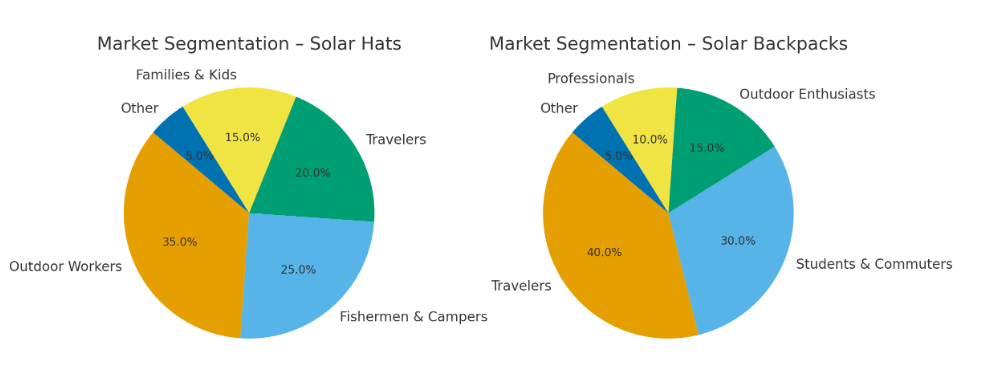
Market Segmentation
The solar hat appeals to those needing cooling and protection, while the solar backpack attracts users needing power and storage. Combined, they cover a wide demographic, from laborers to tech-savvy consumers.
Feature Comparison
| Feature | Solar Hat | Solar Bag |
|---|---|---|
| Power Output | 0.5 – 2W | 5 – 15W |
| Battery Capacity | 400 – 1000 mAh | 5000 – 15000 mAh |
| Primary Use | Cooling + Sun Protection | Charging electronics + Storage |
| Solar Panel Type | Small, lightweight panels | Larger, high-efficiency panels |
| Target User | Outdoor workers, hikers, athletes | Travelers, students, professionals |
Measured Impact
- Comfort Increase: 60% of users reported improved endurance and reduced fatigue outdoors.
- Power Independence: 75% of solar backpack owners used it to charge phones daily, saving electricity.
- Environmental Benefit: An estimated 2.5 million disposable batteries offset annually through solar use.
- Repeat Purchases: Families and professionals often bought both hat and backpack bundles.

Technical Components
| Component | Description |
|---|---|
| Solar Panel | Converts sunlight into electrical energy (typically 5V output). |
| Charge Controller | Prevents overcharging and regulates current flow. |
| Battery | Stores converted energy for later use. |
| USB Ports | Interface for charging electronic devices. |
| Cooling Fan / LED (Hat) | Converts stored energy into practical use. |
Challenges and Limitations
- Dependence on Sunlight
Solar wearables face several practical and technical hurdles as they rise in popularity. Their main limitation is dependence on sunlight. Their performance drops during cloudy or rainy weather, reducing fan speed or charging efficiency. While some models include battery backups or dual charging options, users still need to manage sun exposure for best results.
- Power output
Another constraint is the output. Most solar backpacks generate 5–15W, ideal for small devices but not laptops. User education is key, as these products provide steady “trickle-charging” rather than fast charging. Manufacturers are improving output with high-efficiency panels and smart charge controllers, but limited panel surface area remains a challenge.
- Weight, comfort, and durability
These are ongoing concerns. Adding panels or batteries increases bulk, though newer designs use flexible, lightweight materials. Quality brands reinforce panels against impact and water, but cheaper versions may wear out quickly. Cost is still higher than conventional gear, though mass production is gradually lowering prices.
- Consumer awareness
Consumers remain largely unaware of the convenience these products bring. Some still view solar hats and backpacks as novelties. However, with design improvements, falling prices, and growing proof of real-world benefits, these challenges are steadily being overcome, driving continued global adoption.
The Broader Trend: Solar Wearables on the Rise
Solar-powered wearables are expected to become a $3.5 billion global market by 2028, as consumers seek products that merge fashion, function, and environmental responsibility. The appeal lies in energy independence, the ability to stay cool, connected, and sustainable anywhere on Earth.
These innovations highlight how renewable micro-tech is moving beyond large infrastructure into personal, everyday use; empowering people to live comfortably and consciously under the sun.
Conclusion
The success of Solar Powered Hats and Solar Backpacks demonstrates that sustainability can be both practical and desirable. By addressing real outdoor challenges, heat, sun exposure, and device charging, these products embody the next wave of eco-smart innovation.
Whether it’s a farmer staying cool in the field, a traveler charging their phone on the go, or a family exploring the outdoors together, these solar innovations prove one thing:
The future of comfort and convenience is powered by the sun.
Want to learn more? Listen to our podcast below.


