

The first time someone tries to sell popsicles as a business, it usually starts the same way.
A cooler.
A few plastic molds.
Maybe a borrowed freezer.
You make a small batch, take it out to sell, and it works. People like it. You sell out. It feels like easy money.
So the next day, you double production.
That’s when things start breaking.
You run out of freezer space.
You’re up late filling moulds.
You can’t keep up with demand.
And suddenly, what felt like a simple hustle starts feeling like a bottleneck you created yourself.
This is where most people hit the same decision point:
Do you stay manual… or invest in a machine?
The Real Difference Isn’t Effort; It’s Throughput
On the surface, manual production seems cheaper. And technically, it is… at the start.
But that’s the wrong metric.
What actually matters is how many sellable units you can produce per hour.
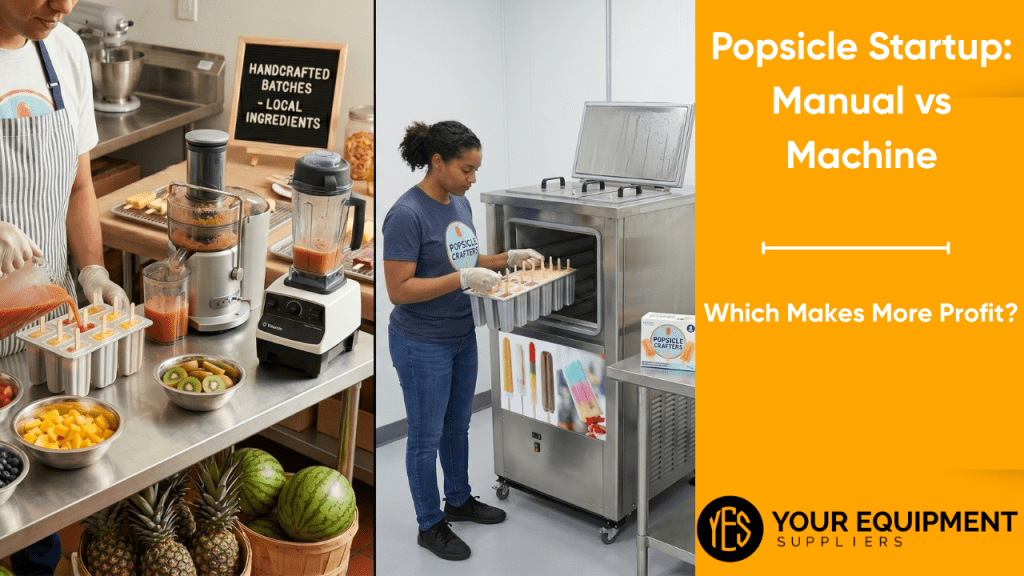
Manual Production Reality
- 50–150 popsicles per batch (depending on moulds)
- 4–8 hour freeze cycle
- Heavy reliance on freezer space
- Labour-intensive (filling, removing, cleaning)
You’re not running a business.
You’re running a cycle constraint.
Machine Production Reality
- 300–3,000+ popsicles per hour (depending on machine)
- Continuous production
- Consistent shape, size, and quality
- Minimal manual handling
Now you’re not waiting on freezing cycles.
You’re controlling output.
That’s a completely different business model.
Let’s Talk Money (Because That’s the Only Thing That Matters)
Here’s where most people fool themselves.
They compare the cost of entry, not the cost per unit.
Manual Setup Example
Looks cheap, right? But here’s the hidden cost:
Let’s say:
That’s $200/day max, assuming you sell everything. |
Machine Setup Example
Now let’s run it:
That’s $1,000/day potential. Same product. |
The Bottleneck You’re Ignoring
Most new entrepreneurs think the constraint is sales.
It’s not.
It’s production capacity.
If you can’t:
- Fulfill bulk orders
- Supply retailers
- Keep inventory consistent
You will never scale past being a “side hustle.”
Manual production locks you into:
- Small batch thinking
- Reactive selling
- Burnout
Machines unlock:
- Wholesale opportunities
- Event supply
- Retail distribution
This is where the real money is.
When Manual Actually Makes Sense
Let’s not pretend machines are always the answer.
Manual production works if:
- You’re validating the product
- You don’t yet have consistent demand
- You’re testing flavors or pricing
- You’re operating at very small scale
In other words:
Manual is for proving the business. Not scaling it.
Stay manual too long, and you’re not being “safe.”
You’re just delaying growth.
The Smart Transition Point
The worst move is not starting manual.
The worst move is waiting too long to switch.
Here’s the simple rule:
If you are consistently selling out or turning down orders, you are already late.
Because by that point:
- Demand exists
- Cash flow exists
- Opportunity exists
And you’re still constrained by production.
That gap? That’s lost revenue.
A More Honest ROI Perspective
Instead of asking:
“Can I afford a machine?”
Ask:
“How much money am I losing by not having one?”
If a machine lets you:
- Increase output by 5x
- Maintain the same margin
- Sell consistently
Then your payback period isn’t years.
It’s months. Sometimes weeks.
The Real Decision
This isn’t about equipment.
It’s about what kind of business you’re trying to build.
If you want:
- A small, manageable side income
→ Stay manual
If you want:
- Retail distribution
- Bulk orders
- Predictable revenue
→ You need a machine
There’s no middle ground for long.
Most people don’t fail in popsicle businesses because the product is bad.
They fail because they build a system that can’t grow.
Manual production feels safe because it’s cheap.
But in reality, it caps your income before you even start.
If you’re serious about turning this into a real business, not just something you do on weekends, you need to think beyond moulds and freezers.
You need to think in volume, consistency, and scale.
If you’re trying to figure out what your numbers actually look like:
Start Your Popsicle Setup → Get the ROI Guide
Break down:
- Your real cost per popsicle
- Production limits
- Machine payback timeline
Because guessing is what keeps businesses small.


